RMS Voltage Tutorial
RMS Voltage Tutorial: Root Mean Square AC Voltage
Introduction to RMS Voltage
When working with alternating current (AC) circuits, one of the most fundamental concepts you must master is RMS voltage (Root Mean Square voltage). Unlike direct current (DC), where voltage remains constant, AC voltage continuously varies in a sinusoidal pattern, constantly changing from zero to a maximum positive value, back through zero to a maximum negative value, and repeating this cycle continuously.
This continuous variation raises an important question: How do we meaningfully describe the “size” or “magnitude” of an AC voltage? Simply stating the peak value doesn’t tell the whole story, because the voltage only reaches that peak instantaneously twice per cycle. We need a way to express AC voltage that relates to its ability to do useful work, similar to how we describe DC voltage.
The answer is RMS voltage—a mathematical value that represents the equivalent DC voltage that would produce the same heating effect (or power dissipation) in a resistive load. When we say that household electricity is “120V” in North America or “230V” in Europe, we’re referring to the RMS voltage, not the peak voltage.
Understanding RMS voltage is crucial for anyone working with AC circuits, from designing power supplies to analyzing signal processing systems. This comprehensive guide will explore the theory, mathematics, and practical applications of RMS voltage, complete with visual diagrams and step-by-step calculations.
What is RMS Voltage?
RMS (Root Mean Square) voltage is the effective value of an AC voltage that produces the same heating effect as an equivalent DC voltage. For a sinusoidal waveform, RMS voltage equals the peak voltage divided by the square root of 2 (approximately 0.707 times the peak value). It represents the “working” voltage of an AC system.
Understanding the Need for RMS Values
The Problem with AC Voltage Measurement
Consider a standard sinusoidal AC voltage waveform. At any given instant, the voltage has a specific value, but this value is constantly changing:
- At time t=0, the voltage might be 0V
- A moment later, it rises to 50V
- Then to 100V
- Reaches a peak of 170V
- Falls back through 100V, 50V, to 0V
- Continues to -50V, -100V, -170V (negative peak)
- And returns to zero to complete the cycle
If we tried to describe this voltage by its instantaneous values, we’d need an infinite number of values—one for every moment in time! This is clearly impractical.
Why Not Just Use Peak Voltage?
You might think we could simply use the peak voltage (the maximum value) to describe an AC waveform. However, this approach has significant limitations:
- Peak voltage is momentary: The waveform only reaches its peak value for an instant, twice per cycle. For the rest of the time, the voltage is lower.
- Peak voltage doesn’t represent power: The ability of a voltage to do work (deliver power to a load) depends on both the voltage magnitude and how long it stays at that magnitude. A brief peak doesn’t deliver as much energy as a sustained voltage.
- Peak voltage is misleading for comparisons: A 170V peak AC voltage doesn’t deliver the same power as 170V DC, even though they have the same peak value.
The Solution: Equivalent Heating Effect
Engineers needed a way to compare AC and DC voltages that reflected their actual ability to do work. The solution was to compare their heating effects in a resistive load.
Imagine you have a resistor connected to a DC voltage source. The resistor heats up due to power dissipation (P = V²/R). Now, if you connect the same resistor to an AC voltage source, it will also heat up, but the heating will vary as the AC voltage changes.
The RMS voltage is defined as the DC voltage value that would produce exactly the same average heating (power dissipation) in the resistor as the AC voltage does. This makes RMS voltage a practical, meaningful measure of AC voltage magnitude.
Why do we use RMS voltage instead of peak voltage?
We use RMS voltage because it represents the equivalent DC voltage that would produce the same power (heating effect) in a resistive load. Peak voltage only occurs instantaneously and doesn’t accurately represent the AC voltage’s ability to do useful work. RMS provides a consistent, practical measure for comparing AC and DC systems.
The Mathematics of RMS Voltage
Deriving the RMS Formula
The term “RMS” stands for Root Mean Square, which describes the mathematical process used to calculate it:
- Square the instantaneous voltage values
- Find the Mean (average) of these squared values over one complete cycle
- Take the Square Root of this average
For a sinusoidal waveform, this process yields a simple relationship between peak voltage and RMS voltage.
The RMS Formula for Sine Waves
For a pure sinusoidal AC voltage:
$V_{RMS} = \frac{V_{peak}}{\sqrt{2}} = V_{peak} \times 0.7071$
Where:
- $V_{RMS}$ = RMS voltage in volts (V)
- $V_{peak}$ = Peak (maximum) voltage in volts (V)
- $\sqrt{2}$ = Square root of 2 (approximately 1.4142)
- 0.7071 = 1/√2 (the RMS factor for sine waves)
Alternative Form: Peak-to-Peak Voltage
Sometimes AC voltages are specified as peak-to-peak voltage ($V_{pp}$), which is the total voltage from the negative peak to the positive peak:
$V_{pp} = 2 \times V_{peak}$
Therefore:
$V_{RMS} = \frac{V_{pp}}{2\sqrt{2}} = V_{pp} \times 0.3536$
The Mathematical Derivation (Advanced)
For those interested in the calculus behind RMS, here’s the formal derivation:
For a sinusoidal voltage $v(t) = V_{peak} \sin(\omega t)$, the RMS value is:
$V_{RMS} = \sqrt{\frac{1}{T} \int_0^T [V_{peak} \sin(\omega t)]^2 dt}$
Where T is the period of one complete cycle.
Solving this integral:
$V_{RMS} = \sqrt{\frac{V_{peak}^2}{T} \int_0^T \sin^2(\omega t) dt}$
$V_{RMS} = \sqrt{\frac{V_{peak}^2}{T} \times \frac{T}{2}}$
$V_{RMS} = \sqrt{\frac{V_{peak}^2}{2}}$
$V_{RMS} = \frac{V_{peak}}{\sqrt{2}}$
This mathematical proof confirms the simple relationship we use in practice.
RMS Voltage Relationships and Conversions
Key Voltage Relationships
For a sinusoidal AC waveform, there are three important voltage measurements:
- Peak Voltage ($V_{peak}$): The maximum instantaneous voltage
- Peak-to-Peak Voltage ($V_{pp}$): The total voltage swing from negative to positive peak
- RMS Voltage ($V_{RMS}$): The effective voltage
These are related by:
$V_{peak} = V_{RMS} \times \sqrt{2} = V_{RMS} \times 1.414$
$V_{pp} = 2 \times V_{peak} = 2 \times V_{RMS} \times \sqrt{2} = V_{RMS} \times 2.828$
$V_{RMS} = V_{peak} \times 0.707 = V_{pp} \times 0.354$
Quick Reference Conversion Table
| If you know: | Multiply by: | To get: |
|---|---|---|
| $V_{RMS}$ | 1.414 | $V_{peak}$ |
| $V_{RMS}$ | 2.828 | $V_{pp}$ |
| $V_{peak}$ | 0.707 | $V_{RMS}$ |
| $V_{peak}$ | 2.0 | $V_{pp}$ |
| $V_{pp}$ | 0.354 | $V_{RMS}$ |
| $V_{pp}$ | 0.5 | $V_{peak}$ |
How do you convert peak voltage to RMS voltage?
To convert peak voltage to RMS voltage, multiply the peak voltage by 0.707 (or divide by √2). For example, if peak voltage is 170V, then RMS voltage = 170 × 0.707 = 120V. Conversely, to convert RMS to peak, multiply by 1.414.
Practical Examples and Calculations
Example 1: Household AC Voltage (North America)
Problem: Standard household voltage in North America is 120V RMS at 60 Hz. Calculate the peak voltage and peak-to-peak voltage.
Solution:
Given: $V_{RMS} = 120\text{V}$
Find Peak Voltage:
$V_{peak} = V_{RMS} \times \sqrt{2}$
$V_{peak} = 120 \times 1.414$
$V_{peak} = 169.7\text{V} \approx 170\text{V}$
Find Peak-to-Peak Voltage:
$V_{pp} = 2 \times V_{peak}$
$V_{pp} = 2 \times 169.7$
$V_{pp} = 339.4\text{V} \approx 340\text{V}$
Interpretation: Although we call it “120V” household power, the voltage actually swings from +170V to -170V, for a total swing of 340V peak-to-peak!
Example 2: European Household AC Voltage
Problem: European household voltage is 230V RMS at 50 Hz. What is the peak voltage?
Solution:
$V_{peak} = 230 \times 1.414$
$V_{peak} = 325.2\text{V}$
The voltage swings from +325V to -325V!
Example 3: Audio Signal Analysis
Problem: An audio amplifier produces a sine wave output with a peak-to-peak voltage of 40V. Calculate the RMS voltage and peak voltage.
Solution:
Given: $V_{pp} = 40\text{V}$
Find Peak Voltage:
$V_{peak} = V_{pp} / 2$
$V_{peak} = 40 / 2$
$V_{peak} = 20\text{V}$
Find RMS Voltage:
$V_{RMS} = V_{peak} \times 0.707$
$V_{RMS} = 20 \times 0.707$
$V_{RMS} = 14.14\text{V}$
Example 4: Power Calculation Using RMS
Problem: A 120V RMS AC source is connected to a 60Ω resistor. Calculate the power dissipated.
Solution:
Using RMS values, we can use the same power formulas as DC:
$P = \frac{V_{RMS}^2}{R}$
$P = \frac{120^2}{60}$
$P = \frac{14400}{60}$
$P = 240\text{W}$
This is the average power dissipated in the resistor. Notice we used RMS voltage just like we would use DC voltage in the power formula!
Visualizing RMS Voltage
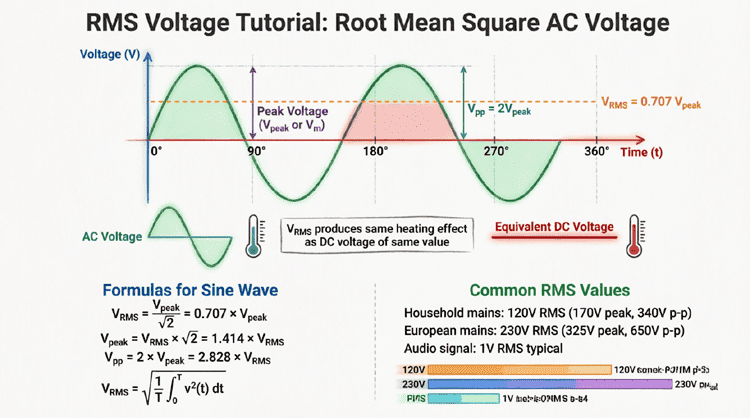
The Sine Wave and RMS Relationship
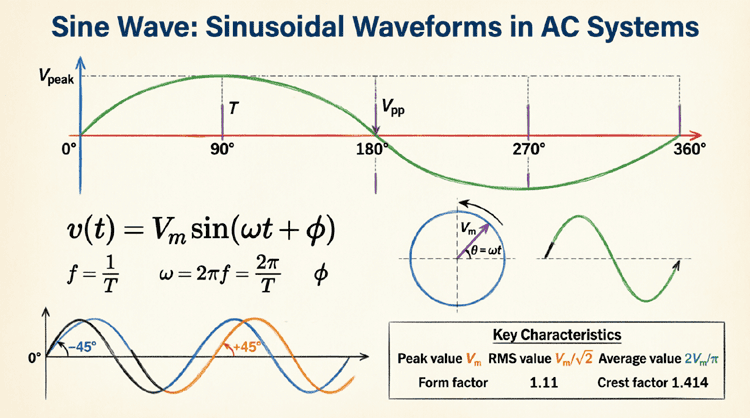
Understanding RMS voltage visually helps solidify the concept. Consider a sinusoidal waveform:
The RMS level (120V in this example) is shown as a horizontal line. Notice that:
- The waveform exceeds the RMS level for part of the cycle
- The waveform is below the RMS level for another part
- The RMS value represents the equivalent heating effect over the entire cycle
Comparing AC and DC Heating Effects
Imagine two identical resistors:
- Resistor A: Connected to 120V DC
- Resistor B: Connected to 120V RMS AC (170V peak)
Both resistors will heat up at exactly the same rate and reach the same temperature! This is the practical meaning of RMS voltage.
RMS Voltage in Power Calculations
Why RMS is Essential for Power
One of the primary reasons RMS voltage is so important is its direct relationship to power calculations. In AC circuits, we can use RMS values in the familiar DC power formulas:
Real Power (Resistive Loads):
- $P = V_{RMS} \times I_{RMS}$
- $P = I_{RMS}^2 \times R$
- $P = \frac{V_{RMS}^2}{R}$
Apparent Power:
- $S = V_{RMS} \times I_{RMS}$ (in VA)
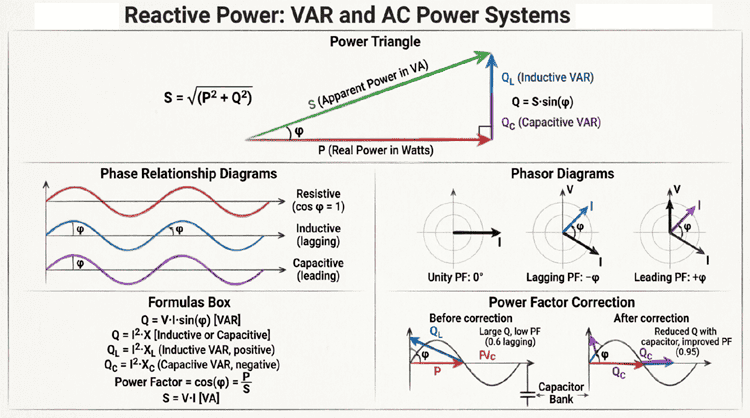
Reactive Power:
- $Q = V_{RMS} \times I_{RMS} \times \sin(\theta)$ (in VAR)
Without RMS values, calculating AC power would require complex integration over time. RMS simplifies this to straightforward algebra.
RMS Current
Just as we have RMS voltage, we also have RMS current. For a sinusoidal current:
$I_{RMS} = \frac{I_{peak}}{\sqrt{2}} = I_{peak} \times 0.707$
When both voltage and current are sinusoidal and in phase (purely resistive load):
$P_{average} = V_{RMS} \times I_{RMS}$
Measuring RMS Voltage
True RMS vs. Average-Responding Meters
Not all multimeters measure RMS voltage the same way:
1. Average-Responding Meters:
- Less expensive
- Assume the waveform is a perfect sine wave
- Measure the average value and multiply by 1.11 to estimate RMS
- Inaccurate for non-sinusoidal waveforms (distorted waves, square waves, etc.)
2. True RMS Meters:
- More expensive
- Actually calculate the true RMS value using the mathematical definition
- Accurate for any waveform shape (sine, square, triangle, distorted, etc.)
- Essential for modern electrical work with non-linear loads
When to Use True RMS Meters
You should use a True RMS meter when measuring:
- Circuits with variable frequency drives (VFDs)
- Switching power supplies
- Dimmer circuits
- Circuits with significant harmonic distortion
- Any non-sinusoidal waveform
For pure sine wave household power, an average-responding meter is usually adequate.
RMS Values for Non-Sinusoidal Waveforms
Different Waveforms, Different RMS Factors
The RMS factor of 0.707 (1/√2) applies only to pure sine waves. Other waveform shapes have different RMS relationships:
Square Wave:
- $V_{RMS} = V_{peak}$ (RMS equals peak)
- RMS Factor = 1.0
Triangle Wave:
- $V_{RMS} = V_{peak} / \sqrt{3}$
- RMS Factor = 0.577
Sawtooth Wave:
- $V_{RMS} = V_{peak} / \sqrt{3}$
- RMS Factor = 0.577
Pulse Wave (Duty Cycle D):
- $V_{RMS} = V_{peak} \times \sqrt{D}$
- Where D is the duty cycle (0 to 1)
Why Waveform Shape Matters
In modern electrical systems, waveforms are often distorted due to:
- Non-linear loads (computers, LED lights, variable speed drives)
- Harmonics from rectifiers and inverters
- Switching transients
These distortions change the RMS value relative to the peak, which is why True RMS meters are essential for accurate measurements in modern installations.
Practical Applications of RMS Voltage
1. Electrical Power Distribution
Utility companies specify distribution voltages in RMS values:
- Residential: 120V/240V RMS (North America), 230V RMS (Europe)
- Industrial: 480V RMS, 600V RMS
- Transmission: 13.8kV, 69kV, 138kV, 230kV, 500kV RMS
All electrical equipment ratings (motors, transformers, appliances) are based on RMS voltage.
2. Audio Engineering
Audio signal levels are typically specified in RMS volts:
- Line level: 1V RMS (professional), 0.316V RMS (consumer)
- Speaker outputs: Specified in RMS watts into RMS volts
- RMS power ratings indicate continuous power handling capability
3. AC Motor and Transformer Design
Motor and transformer nameplates show RMS voltage ratings. The insulation, winding design, and magnetic core are all designed based on RMS voltage and the associated peak voltage stress.
4. Circuit Breaker and Fuse Ratings
Protective devices are rated for RMS voltage and RMS current. They must safely interrupt fault currents at the system’s RMS voltage level.
5. Oscilloscope Measurements
While oscilloscopes display instantaneous voltage vs. time, modern digital scopes can calculate and display RMS voltage automatically, making it easy to verify RMS values.
Common Mistakes and Misconceptions
Mistake 1: Confusing Peak and RMS
Wrong: “My oscilloscope shows 170V peak, so this is 170V AC.”
Correct: “My oscilloscope shows 170V peak, so this is 120V RMS AC.”
Always specify whether you’re referring to peak or RMS values!
Mistake 2: Using Peak Voltage in Power Calculations
Wrong: $P = V_{peak}^2 / R$
Correct: $P = V_{RMS}^2 / R$
Using peak voltage will give you twice the actual power!
Mistake 3: Assuming All Meters Read True RMS
Many inexpensive multimeters do NOT read True RMS. They assume a sine wave and will give incorrect readings for distorted waveforms. Always check your meter’s specifications.
Misconception: RMS is the “Average” Voltage
RMS is NOT the average voltage. The average of a symmetrical AC waveform over one complete cycle is zero (positive and negative halves cancel). RMS is the root mean square—a different mathematical concept entirely.
Summary and Conclusion
RMS voltage is the cornerstone of AC circuit analysis and measurement. It provides a meaningful, practical way to describe AC voltage magnitude that directly relates to power delivery and work capability.
Key takeaways from this guide include:
- Definition: RMS voltage is the equivalent DC voltage that produces the same heating effect in a resistive load
- Formula for Sine Waves: $V_{RMS} = V_{peak} / \sqrt{2} = V_{peak} \times 0.707$
- Conversions:
- Peak to RMS: Multiply by 0.707
- RMS to Peak: Multiply by 1.414
- Peak-to-Peak to RMS: Multiply by 0.354
- Power Calculations: RMS values allow us to use DC power formulas for AC circuits
- Measurement: True RMS meters are essential for accurate measurements of non-sinusoidal waveforms
- Applications: RMS voltage is used universally in power distribution, equipment ratings, and circuit design
Understanding RMS voltage is fundamental to working with AC systems. Whether you’re designing circuits, troubleshooting electrical systems, or simply trying to understand your home’s electrical supply, RMS voltage is the key concept that makes AC power practical and measurable.
As you continue your electrical engineering journey, remember that RMS values are your bridge between the theoretical world of sinusoidal waveforms and the practical world of real power, real work, and real measurements.