Electromagnetism
Electromagnetism: The Complete Guide to Magnetic Fields from Electric Current
Introduction to Electromagnetism
For centuries, electricity and magnetism were considered two completely separate forces of nature. That changed forever in 1820 when a Danish physicist named Hans Christian Ørsted noticed that a compass needle deflected when placed near a wire carrying an electric current. This groundbreaking observation revealed a profound truth: electricity and magnetism are intrinsically linked.
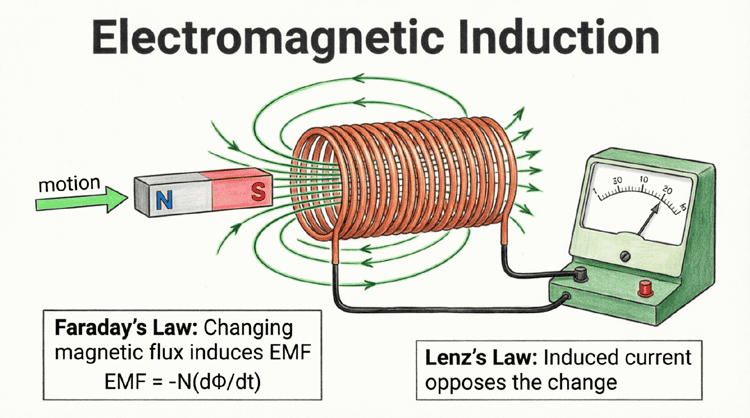
Electromagnetism is the branch of physics that studies the interaction between electric charges and magnetic fields. It dictates that moving electric charges (currents) generate magnetic fields, and conversely, changing magnetic fields can induce electric currents (a concept we will explore in depth in the next article on Electromagnetic Induction).
Understanding electromagnetism is the cornerstone of modern electrical engineering. It is the fundamental principle behind electric motors, generators, transformers, relays, loudspeakers, and even the hard drives that store our digital data. This comprehensive guide will explore how electric currents create magnetic fields, the rules used to determine their direction, the mathematics governing their strength, and the practical applications that power our modern world.
What is Electromagnetism?
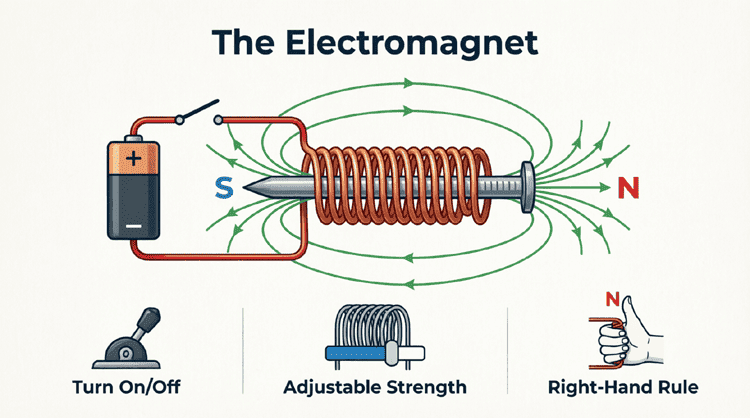
Electromagnetism is the physical phenomenon where electric currents generate magnetic fields. When an electric current flows through a conductor, it creates a circular magnetic field around the wire. By coiling the wire into a solenoid or wrapping it around an iron core, this magnetic field can be concentrated and amplified to create powerful, controllable electromagnets.
The Discovery of Electromagnetism
Before 1820, scientists studied static electricity and permanent magnets as isolated phenomena. During a lecture demonstration, Hans Christian Ørsted set up a simple circuit with a battery and a wire. He noticed that a magnetic compass placed on the table near the wire twitched and aligned itself perpendicular to the wire when the current was turned on.
This simple experiment proved that an electric current produces a magnetic field. It unified two fundamental forces and paved the way for the inventions of the electromagnet, the electric motor, and the generator, effectively launching the Second Industrial Revolution.
Magnetic Field Around a Straight Conductor
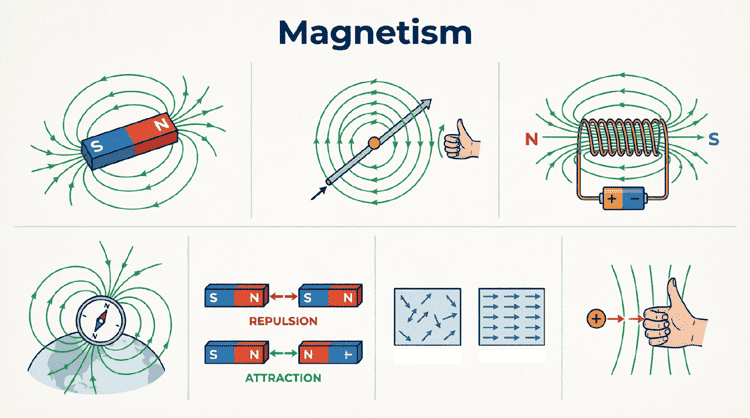
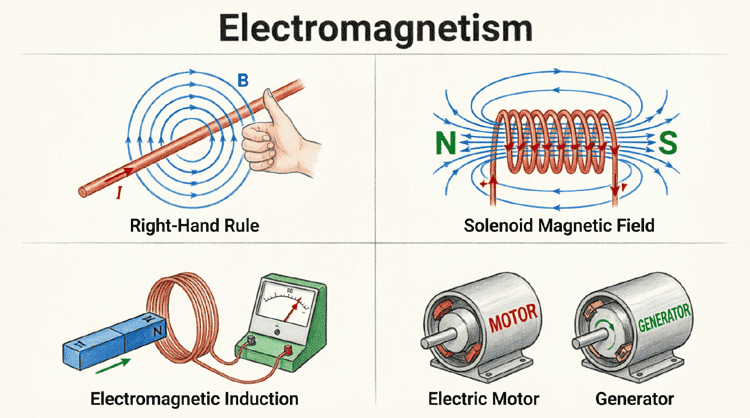
When a direct current (DC) flows through a straight wire, it generates a magnetic field in the space surrounding the wire. Unlike the field of a bar magnet, which flows from north to south, the magnetic field around a straight current-carrying conductor forms concentric circles centered on the wire.
The Right-Hand Rule (Thumb Rule)
To determine the direction of this circular magnetic field, we use the Right-Hand Rule (also known as the Right-Hand Grip Rule for straight conductors):
- Imagine gripping the current-carrying wire with your right hand.
- Point your thumb in the direction of the conventional current flow (from positive to negative).
- The direction in which your fingers curl around the wire indicates the direction of the magnetic field lines.
If the current flows upward, the magnetic field circles the wire in a counter-clockwise direction (when viewed from above). If the current flows downward, the field circles clockwise.
Mathematical Representation: Ampere’s Law
The strength of the magnetic field ($B$) generated by a long, straight current-carrying wire depends on the amount of current ($I$) and the distance ($r$) from the wire. This is described by Ampere’s Law (derived from the Biot-Savart Law):
$B = \frac{\mu_0 I}{2\pi r}$
Where:
- $B$ = Magnetic flux density in Tesla (T)
- $\mu_0$ = Permeability of free space ($4\pi \times 10^{-7}$ T·m/A)
- $I$ = Current in Amperes (A)
- $r$ = Radial distance from the wire in meters (m)
Key Takeaways from the Formula:
- The magnetic field is directly proportional to the current. Doubling the current doubles the field strength.
- The magnetic field is inversely proportional to the distance. As you move further from the wire, the field strength drops rapidly.
How do you find the direction of a magnetic field around a wire?
Use the Right-Hand Rule. Point the thumb of your right hand in the direction of the conventional current. The natural curl of your fingers shows the direction of the circular magnetic field lines around the conductor.
The Solenoid: Creating a Bar Magnet from Wire
While a straight wire produces a weak, circular magnetic field, we can concentrate and amplify this field by bending the wire into loops. A long, cylindrical coil of wire is called a solenoid.
Magnetic Field of a Solenoid
When current flows through a solenoid, the individual circular magnetic fields of each loop combine to create a strong, uniform magnetic field inside the coil. Outside the coil, the field closely resembles that of a standard bar magnet, with distinct North and South poles at either end.
Inside the Solenoid:
The magnetic field lines are straight, parallel, and densely packed, indicating a strong and uniform magnetic field.
Outside the Solenoid:
The field lines emerge from the North pole, curve around the outside, and enter the South pole, just like a permanent magnet.
The Right-Hand Rule for Coils
To determine the polarity (North and South poles) of a solenoid, we use a variation of the Right-Hand Rule:
- Wrap the fingers of your right hand around the coil in the direction of the conventional current flow.
- Your extended thumb will point toward the North pole of the solenoid.
Factors Affecting Solenoid Field Strength
The magnetic flux density ($B$) inside an ideal, long solenoid is given by the formula:
$B = \mu_0 n I$
Where:
- $n$ = Number of turns per unit length ($N/L$)
- $I$ = Current in Amperes
- $\mu_0$ = Permeability of the core material
To increase the strength of an electromagnet (a solenoid with a core), you can:
- Increase the current ($I$): More current creates a stronger field.
- Increase the number of turns ($N$): More loops concentrate the magnetic flux.
- Use a ferromagnetic core: Replacing the air core with iron or steel increases the permeability ($\mu$) by thousands of times, massively amplifying the field.
The Lorentz Force: Magnetism Acting on Current
Just as an electric current creates a magnetic field, a magnetic field exerts a force on a current-carrying conductor. This interaction is known as the Lorentz Force (specifically, the magnetic component of the Lorentz force).
Fleming’s Left-Hand Rule
To determine the direction of the force exerted on a wire placed in an external magnetic field, we use Fleming’s Left-Hand Rule:
- Hold your left hand so that your thumb, index finger, and middle finger are all at right angles (90 degrees) to each other.
- Point your First (Index) Finger in the direction of the external magnetic Field (North to South).
- Point your SeCond (Middle) Finger in the direction of the Current (Positive to Negative).
- Your Thumb will now point in the direction of the resulting Motion or Force.
(Mnemonic: First finger = Field, Center finger = Current, Thumb = Thrust/Force).
Calculating the Magnetic Force
The magnitude of the force ($F$) acting on a straight conductor of length ($L$) carrying current ($I$) in a uniform magnetic field ($B$) is calculated as:
$F = B \cdot I \cdot L \cdot \sin(\theta)$
Where:
- $F$ = Force in Newtons (N)
- $B$ = Magnetic flux density in Tesla (T)
- $I$ = Current in Amperes (A)
- $L$ = Length of the conductor in the magnetic field in meters (m)
- $\theta$ = Angle between the conductor and the magnetic field
Key Takeaways:
- Maximum force occurs when the wire is perpendicular to the field ($\theta = 90^\circ$, $\sin(90^\circ) = 1$).
- Zero force occurs when the wire is parallel to the field ($\theta = 0^\circ$, $\sin(0^\circ) = 0$).
What is the Lorentz Force in electromagnetism?
The Lorentz force is the physical force exerted on a current-carrying conductor when it is placed inside an external magnetic field. The direction of this force is determined by Fleming’s Left-Hand Rule, and its magnitude is calculated using F = BIL sin(θ). This principle is the foundational mechanism behind electric motors.
Practical Applications of Electromagnetism
The ability to control magnetic fields using electric currents has revolutionized technology. Here are some of the most critical applications:
1. Electric Motors
Electric motors convert electrical energy into mechanical energy. They utilize the Lorentz force. A coil of wire (armature) is placed inside a permanent magnetic field. When current flows through the coil, the Lorentz force pushes one side of the coil up and the other side down, creating rotational torque. A commutator reverses the current every half-turn to keep the motor spinning continuously.
2. Electromagnetic Relays and Solenoids
A relay is an electrically operated switch. A small control current flows through a solenoid coil, creating a magnetic field that pulls a metal armature. This physical movement closes or opens a separate, high-power electrical circuit. Solenoids are used in car starters, door locks, and industrial valves.
3. Loudspeakers
In a dynamic loudspeaker, an audio signal (alternating current) is sent through a voice coil suspended in a permanent magnetic field. The varying current creates a varying electromagnetic force (Lorentz force) that pushes and pulls the coil back and forth. The coil is attached to a paper or plastic cone, which vibrates the air to produce sound.
4. Particle Accelerators and Mass Spectrometers
In physics and chemistry, powerful electromagnets are used to steer and focus beams of charged particles. Because the Lorentz force acts perpendicular to the velocity of moving charges, it forces particles to travel in circular or spiral paths, allowing scientists to smash them together or separate them by mass.
Practical Examples and Calculations
Example 1: Magnetic Field of a Straight Wire
Problem: A straight vertical wire carries a current of 15 A upward. Calculate the magnetic flux density at a point 5 cm away from the wire. Also, state the direction of the field.
Solution:
Given:
- $I = 15 \text{ A}$
- $r = 5 \text{ cm} = 0.05 \text{ m}$
- $\mu_0 = 4\pi \times 10^{-7} \text{ T·m/A}$
Formula:
$B = \frac{\mu_0 I}{2\pi r}$
Calculation:
$B = \frac{(4\pi \times 10^{-7}) \times 15}{2\pi \times 0.05}$
$B = \frac{2 \times 10^{-7} \times 15}{0.05}$
$B = \frac{30 \times 10^{-7}}{0.05}$
$B = 600 \times 10^{-7} \text{ T} = 60 \text{ \mu T}$
Direction: Using the Right-Hand Rule (thumb pointing up), the fingers curl counter-clockwise. Therefore, the magnetic field forms counter-clockwise concentric circles around the wire.
Example 2: Force on a Conductor (Lorentz Force)
Problem: A 20 cm long wire carries a current of 8 A. It is placed perpendicular to a uniform magnetic field of 0.5 T. Calculate the force acting on the wire.
Solution:
Given:
- $L = 20 \text{ cm} = 0.2 \text{ m}$
- $I = 8 \text{ A}$
- $B = 0.5 \text{ T}$
- $\theta = 90^\circ$ (perpendicular)
Formula:
$F = B \cdot I \cdot L \cdot \sin(\theta)$
Calculation:
$F = 0.5 \times 8 \times 0.2 \times \sin(90^\circ)$
$F = 0.5 \times 8 \times 0.2 \times 1$
$F = 0.8 \text{ Newtons}$
The wire experiences a force of 0.8 N. The exact direction (up, down, left, or right) would be determined by applying Fleming’s Left-Hand Rule based on the specific orientation of the current and magnetic field.
Electromagnetism is the bridge that connects the flow of electrons to the invisible forces of magnetism. By understanding that moving charges generate magnetic fields, and that magnetic fields exert forces on moving charges, we unlock the ability to convert electrical energy into mechanical motion and vice versa.
Key takeaways from this guide include:
- The Core Principle: An electric current flowing through a conductor generates a circular magnetic field around it.
- Direction Rules: The Right-Hand Rule determines the field direction around a straight wire, while the Right-Hand Grip Rule determines the North pole of a solenoid.
- Solenoids: Coiling a wire concentrates the magnetic field. Adding a ferromagnetic core creates a powerful, controllable electromagnet.
- The Lorentz Force: A current-carrying wire in an external magnetic field experiences a physical force, governed by Fleming’s Left-Hand Rule and the formula $F = BIL\sin(\theta)$.
- Real-World Impact: These principles are the driving force behind electric motors, relays, loudspeakers, and modern medical imaging devices.
Electromagnetism is not just a theoretical concept; it is the invisible engine of the modern world. In the next article, we will explore The Electromagnet, diving deeper into how we engineer these principles to build practical, high-strength magnetic devices for industrial and commercial use.