Open-loop Systems
Open-loop System: Complete Guide to Open-loop Control Systems
Introduction to Open-loop Systems
In the world of control systems, open-loop systems represent the simplest and most fundamental type of control architecture. These systems operate without any feedback from the output to the input, meaning the controller has no information about whether the desired outcome has been achieved.
An open-loop system is a control system where the output has no influence on the input or control action. The controller follows a pre-determined sequence or algorithm regardless of the actual output or process conditions. This “fire and forget” approach makes open-loop systems straightforward to design and implement but also limits their accuracy and adaptability.
Despite their simplicity, open-loop systems are widely used in applications where:
- Precision is not critical
- Cost is a major concern
- The process is predictable and stable
- Disturbances are minimal
- Safety is not compromised by potential errors
Understanding open-loop systems is essential because they form the foundation of more complex control architectures. They represent the simplest control strategy—applying a fixed input to achieve a desired output—before adding the complexity of feedback mechanisms.
This comprehensive guide will explore every aspect of open-loop systems, from their basic principles and components to their advantages, disadvantages, practical applications, and design considerations. Whether you’re designing a simple appliance or studying control theory, understanding open-loop systems is crucial for building your knowledge base.
What is an Open-loop System?
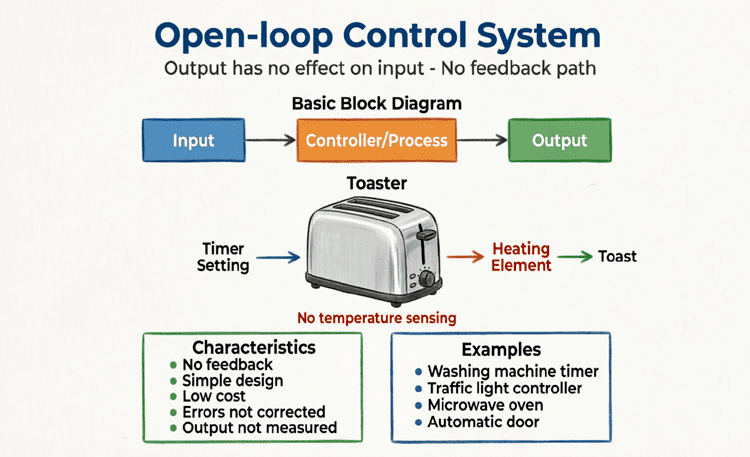
An open-loop system is a control system where the output has no influence on the input or control action. It follows a pre-determined sequence without any feedback, making it simple but less accurate than closed-loop systems.
How Open-loop Systems Work
Basic Operation Principle
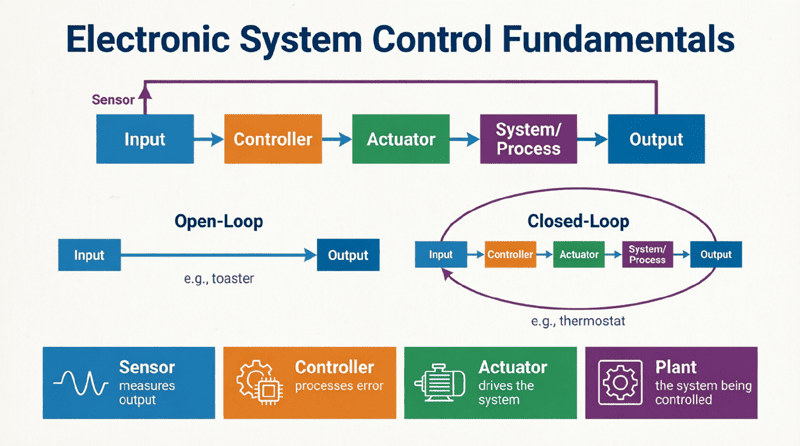
In an open-loop system, the controller sends a command to the actuator based on a predetermined input, without any knowledge of the resulting output. The system assumes that the same input will always produce the same output under all conditions.
Signal Flow in Open-loop Systems:
[Input] → [Controller] → [Actuator] → [Process] → [Output]Unlike closed-loop systems, there is no feedback path connecting the output back to the controller.
Key Components
1. Input/Command:
- The desired action or setpoint
- Example: “Turn on heater for 10 minutes”
- Can be a fixed value or time-based sequence
2. Controller:
- Processes the input command
- Generates control signal
- Does not modify control based on output
- Example: Simple timer or switch
3. Actuator:
- Executes the control signal
- Converts electrical signal to physical action
- Example: Relay, valve, motor
4. Process:
- The system being controlled
- Example: Room, heating element, motor
5. Output:
- The result of the process
- Example: Temperature, position, speed
- Not monitored or used for correction
Mathematical Representation
For a linear open-loop system:
$y = G \cdot u$
Where:
- y = Output
- G = System gain (fixed)
- u = Input/Control signal
Unlike closed-loop systems, the output is not used to modify the input. The system gain G is assumed to be constant and known.
Example: Simple Heating System
Scenario: A room heater with a timer.
Components:
- Input: Timer setting (e.g., “ON for 30 minutes”)
- Controller: Simple timer circuit
- Actuator: Relay that powers the heater
- Process: Room heating
- Output: Room temperature (not measured)
Operation:
- User sets timer to 30 minutes
- Timer starts, relay closes, heater turns ON
- After 30 minutes, relay opens, heater turns OFF
- Process ends, regardless of actual room temperature
Limitation: If the room was already warm, it might overheat. If it was very cold, it might not reach the desired temperature.
Advantages of Open-loop Systems
1. Simplicity
Design Simplicity:
- Fewer components (no sensors or feedback circuitry)
- Easier to understand and troubleshoot
- Straightforward implementation
Implementation Simplicity:
- No complex control algorithms needed
- Simple wiring and connections
- Minimal programming (if digital)
Example: A washing machine timer requires only a simple motor to advance the cycle, while a closed-loop version would need multiple sensors and a complex controller.
2. Cost-Effectiveness
Lower Component Cost:
- No need for expensive sensors
- Simpler controller (e.g., mechanical timer vs. microcontroller)
- Less wiring and infrastructure
Reduced Development Cost:
- Shorter design time
- Less testing and calibration
- Lower engineering expertise required
Example: A simple fan with a speed dial costs significantly less than one with a smart speed controller that adjusts based on temperature.
3. Reliability
Fewer Failure Points:
- Fewer components = fewer things that can fail
- No feedback sensors to malfunction
- Simpler electronics are generally more reliable
Predictable Behavior:
- Consistent response to inputs
- No unexpected oscillations or instabilities
- Easier to verify and validate
Example: Traffic light controllers often use open-loop timing because they’re highly reliable and simple.
4. Stability
Inherently Stable:
- No feedback means no potential for oscillation
- No risk of instability from feedback loop
- No need to design for stability margins
Simpler Analysis:
- No need to analyze closed-loop stability
- Straightforward system analysis
- Predictable transient response
Example: A simple conveyor belt system doesn’t need feedback to operate stably, so an open-loop approach is ideal.
5. Speed
No Processing Delay:
- No need to process feedback signals
- Faster response to inputs
- No sampling or conversion delays
Simpler Control:
- Direct control action
- No control calculations needed
- Immediate response
Example: A high-speed packaging system that needs to act immediately without feedback delays.
Disadvantages of Open-loop Systems
1. Lack of Error Correction
No Adjustment:
- Cannot correct for errors
- Cannot compensate for disturbances
- Cannot adapt to changing conditions
Inaccuracy:
- Output may differ from desired
- Process variations cause errors
- Cannot detect or correct errors
Example: A timer-based oven may undercook or overcook food depending on initial conditions.
2. Sensitivity to Disturbances
External Interference:
- Affected by environmental changes
- Sensitive to load variations
- Vulnerable to process parameter changes
Example: An open-loop heating system in a room with drafts will fail to maintain temperature.
3. Inability to Adapt
Fixed Response:
- Cannot adapt to changing conditions
- Cannot optimize performance
- Cannot learn from experience
Example: A washing machine that uses fixed water levels won’t adjust for different fabric types.
4. Inability to Handle Nonlinearities
Fixed Control Strategy:
- Cannot compensate for nonlinearities
- Fixed gain assumes linear behavior
- Performance degrades with nonlinear processes
Example: A simple timer-based motor controller won’t handle different loads effectively.
5. No Performance Monitoring
No Verification:
- Cannot verify output was achieved
- No way to detect failures
- No data for process improvement
Example: A timer-based irrigation system can’t verify if water reached the plants.
Practical Examples of Open-loop Systems
1. Washing Machine Timer
Description: Early washing machines used simple timers for cycle control.
Components:
- Input: Cycle selection knob
- Controller: Mechanical timer
- Actuator: Relays controlling water valves and motor
- Process: Washing cycle
- Output: Clean clothes (not monitored)
Operation:
- User selects cycle
- Timer advances through predetermined steps
- Water fills for fixed time
- Agitation runs for fixed time
- Rinsing and spinning follow fixed sequence
Why Open-loop Works:
- Cycle timing is consistent
- Water levels are approximate
- Process is predictable
- Cost is minimized
2. Automatic Door Opener
Description: Simple door openers that trigger for a fixed duration.
Components:
- Input: Motion sensor or button
- Controller: Timer circuit
- Actuator: Motor to open door
- Process: Door movement
- Output: Door position (not monitored)
Operation:
- Sensor detects motion
- Timer starts, door opens
- After fixed time (e.g., 15 seconds), door closes
Why Open-loop Works:
- Door movement is consistent
- Safety is ensured by timing
- Simple and reliable
- Cost-effective for basic applications
3. Traffic Light System
Description: Fixed-time traffic light controllers.
Components:
- Input: Time (pre-set cycle)
- Controller: Timing circuit
- Actuator: Relays controlling lights
- Process: Traffic flow
- Output: Light sequence (not monitored)
Operation:
- Timer advances through pre-set sequence
- Lights change at fixed intervals
- Cycle repeats continuously
Why Open-loop Works:
- Traffic patterns are predictable in many areas
- Simplicity ensures reliability
- Low maintenance requirements
- Cost-effective for simple intersections
4. Simple Heating System
Description: Basic room heater with a timer.
Components:
- Input: Timer setting
- Controller: Simple timer
- Actuator: Relay controlling heater
- Process: Room heating
- Output: Room temperature (not monitored)
Operation:
- User sets timer duration
- Timer starts, heater turns ON
- After fixed time, heater turns OFF
Why Open-loop Works:
- When exact temperature control isn’t needed
- In stable environments with minimal disturbances
- When simplicity and cost are priorities
Design Considerations for Open-loop Systems
1. Process Understanding
Characterize the Process:
- Understand process dynamics
- Identify key parameters
- Model input-output relationship
Example: For a conveyor belt system, characterize speed vs. voltage relationship.
2. Disturbance Analysis
Identify Disturbances:
- Environmental factors
- Load variations
- Parameter changes
Example: For an oven, identify effects of ambient temperature and load variations.
3. Tolerance Analysis
Determine Tolerance:
- How much output variation is acceptable?
- What error margin is needed?
- What’s the required precision?
Example: A timer-based oven might tolerate ±5°C variation.
4. Safety Considerations
Fail-Safe Design:
- Safety mechanisms for open-loop failures
- Emergency stop
- Over-temperature protection
Example: A timer-based heater should have a thermal cutoff.
5. Calibration
Periodic Calibration:
- Adjust for process changes
- Verify performance
- Compensate for drift
Example: Industrial timers might need monthly calibration.
6. When to Use Open-loop
Good Candidates:
- Stable processes with minimal disturbances
- Predictable input-output relationships
- Low precision requirements
- Cost-sensitive applications
- Safety-critical systems where feedback could cause instability
Poor Candidates:
- Unstable processes
- Systems with significant disturbances
- High precision requirements
- Safety-critical systems where error is unacceptable
Open-loop vs. Closed-loop Systems
Comparison Table
| Characteristic | Open-loop System | Closed-loop System |
|---|---|---|
| Feedback | No feedback | Feedback path |
| Accuracy | Lower (no error correction) | Higher (error correction) |
| Cost | Lower (simpler) | Higher (more components) |
| Complexity | Lower | Higher |
| Stability | Inherently stable | Requires stability analysis |
| Disturbance Rejection | Poor | Good |
| Adaptability | None | Can adapt to changes |
| Reliability | High (fewer components) | Lower (more failure points) |
| Design Time | Short | Long |
| Speed | Fast (no feedback delay) | Slower (feedback processing) |
| Use Cases | Simple, predictable systems | Precise, critical systems |
When to Choose Open-loop
Choose Open-loop When:
- Process is stable and predictable
- Disturbances are minimal
- Cost is a major concern
- Simplicity is valued
- Safety is ensured by design
- Precision requirements are low
- Speed is critical
Choose Closed-loop When:
- Precision is critical
- Disturbances are significant
- Process parameters vary
- Safety requires error correction
- High reliability is essential
- Process must adapt to changes
Hybrid Approaches
Open-loop with Periodic Calibration:
- Use open-loop control
- Periodically verify output
- Adjust setpoints based on measurements
- Example: Industrial timers with daily calibration
Open-loop with Safety Limits:
- Use open-loop control
- Add safety sensors for critical parameters
- Example: Timer-based oven with thermal cutoff
Open-loop with Feedforward:
- Measure disturbances
- Adjust input based on disturbance
- Example: Air conditioning with outdoor temperature compensation
Open-loop systems represent the simplest form of control architecture, operating without feedback from the output to the input. While they lack the precision and adaptability of closed-loop systems, they offer significant advantages in simplicity, cost, reliability, and stability.
Key takeaways from this guide include:
- Definition: Open-loop systems operate without feedback—controller sends commands without knowing the output result.
- Signal Flow: Input → Controller → Actuator → Process → Output (no feedback path).
- Advantages:
- Simplicity in design and implementation
- Cost-effectiveness (fewer components)
- Reliability (fewer failure points)
- Inherent stability (no oscillation risk)
- Speed (no feedback delay)
- Disadvantages:
- Lack of error correction
- Sensitivity to disturbances
- Inability to adapt to changing conditions
- Inability to handle nonlinearities
- No performance monitoring
- Design Considerations:
- Process understanding is critical
- Disturbance analysis essential
- Tolerance analysis required
- Safety mechanisms vital
- Periodic calibration may be needed
- Practical Applications:
- Washing machine timers
- Automatic door openers
- Traffic light systems
- Simple heating systems
- When to Use:
- Stable processes with minimal disturbances
- Predictable input-output relationships
- Low precision requirements
- Cost-sensitive applications
- Safety-critical systems where feedback could cause instability
Understanding open-loop systems provides the foundation for more advanced control techniques. While they may not be suitable for all applications, their simplicity and reliability make them invaluable in many real-world scenarios. The key is to recognize when open-loop control is sufficient and when more advanced techniques are necessary.
As you continue your journey in control systems engineering, remember that the simplest solution is often the best one. Open-loop systems exemplify this principle—using minimal components to achieve reliable control in appropriate applications. Mastering this fundamental concept will serve you well as you explore more complex control architectures.