Feedback Systems
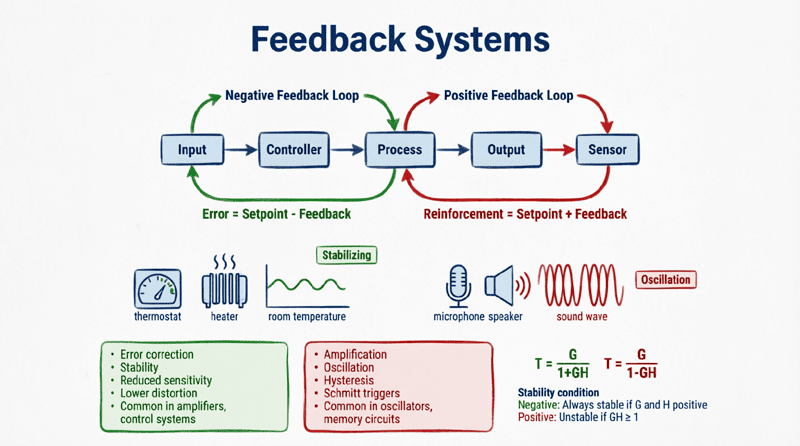
Feedback Systems: Complete Guide to Positive and Negative Feedback Control
Introduction to Feedback Systems
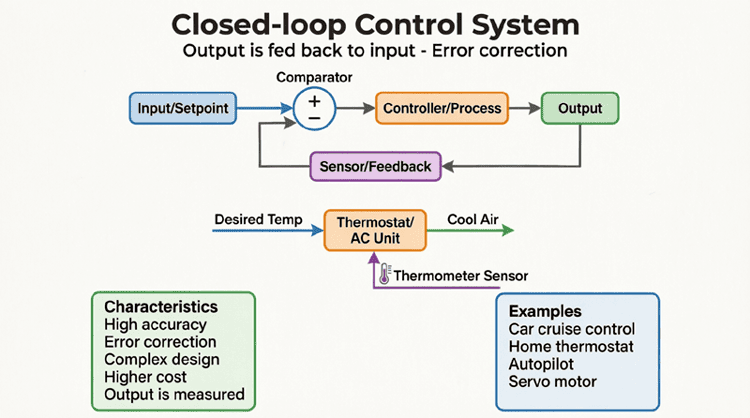
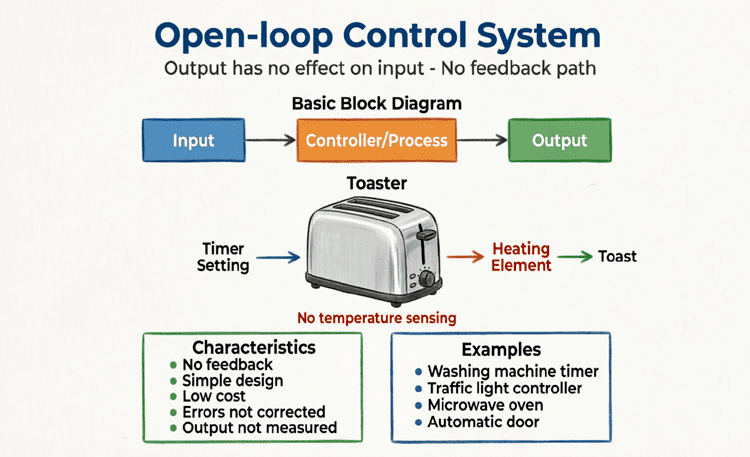
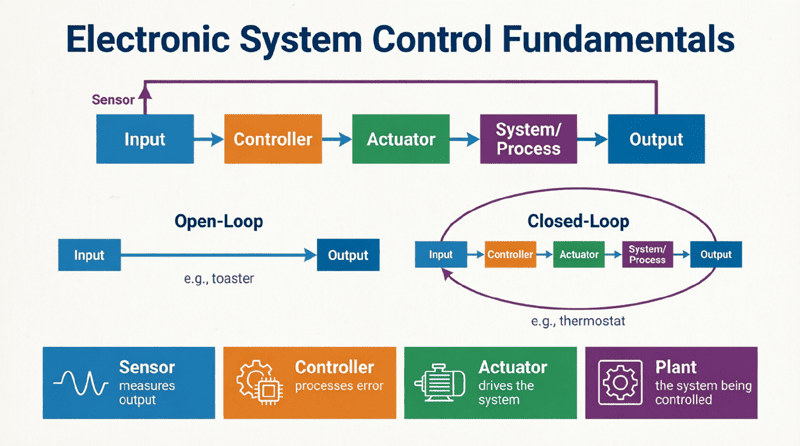
Feedback is one of the most fundamental and powerful concepts in engineering, biology, economics, and countless other fields. In control systems, feedback systems use information about the system’s output to modify its input, creating a closed loop that enables automatic regulation, adaptation, and control.
A feedback system is a system in which a portion of the output signal is fed back to the input, either to reinforce (positive feedback) or counteract (negative feedback) the original input signal. This feedback mechanism allows systems to self-regulate, maintain stability, amplify signals, or generate oscillations, depending on the type and configuration of feedback employed.
Feedback systems are ubiquitous in nature and technology:
- Biological Systems: Body temperature regulation, blood sugar control, hormone regulation
- Electronics: Amplifiers, oscillators, voltage regulators
- Control Systems: Temperature control, speed control, position control
- Economics: Market feedback, supply and demand
- Social Systems: Population dynamics, learning processes
Understanding feedback systems is crucial because they:
- Enable automatic control without human intervention
- Improve system performance and accuracy
- Enhance stability and robustness
- Allow adaptation to changing conditions
- Create complex behaviors from simple components
This comprehensive guide will explore the fundamentals of feedback systems, the critical differences between positive and negative feedback, their applications, stability considerations, and design principles. Whether you’re designing an amplifier, studying biological systems, or building a control system, mastering feedback concepts is essential.
What is a Feedback System?
A feedback system is a system where a portion of the output is returned to the input to influence system behavior. Negative feedback reduces errors and stabilizes systems, while positive feedback amplifies signals and can create oscillations or instability.
Types of Feedback Systems
Feedback systems are classified into two fundamental types based on how the feedback signal interacts with the input signal.
1. Negative Feedback Systems
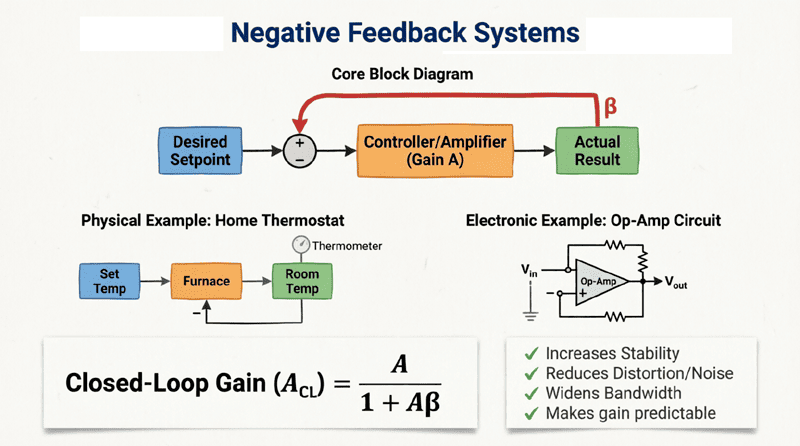
Definition: Negative feedback occurs when the feedback signal opposes or subtracts from the input signal, reducing the overall system gain but improving stability and accuracy.
Mathematical Representation:
For a system with forward gain A and feedback factor β:
Closed-loop Gain:
$A_{CL} = \frac{A}{1 + A\beta}$
Where:
- A = Open-loop gain
- β = Feedback factor (0 < β < 1)
- Aβ = Loop gain
Key Characteristics:
Error Reduction:
- Reduces difference between desired and actual output
- Minimizes steady-state error
- Improves accuracy
Stability Enhancement:
- Damps oscillations
- Improves stability margins
- Reduces sensitivity to parameter variations
Bandwidth Extension:
- Increases system bandwidth
- Improves frequency response
- Faster response to changes
Linearization:
- Reduces nonlinear distortion
- Makes system more linear
- Improves signal fidelity
Example: Operational amplifier with negative feedback maintains precise gain despite component variations.
2. Positive Feedback Systems
Definition: Positive feedback occurs when the feedback signal reinforces or adds to the input signal, increasing the overall system gain and potentially causing instability or oscillation.
Mathematical Representation:
For a system with forward gain A and feedback factor β:
Closed-loop Gain:
$A_{CL} = \frac{A}{1 – A\beta}$
Where:
- A = Open-loop gain
- β = Feedback factor
- Aβ = Loop gain
Key Characteristics:
Signal Amplification:
- Increases system gain
- Amplifies small signals
- Can create large outputs from small inputs
Oscillation Generation:
- Can create sustained oscillations
- Used in oscillator circuits
- Generates periodic signals
Instability:
- Can cause system instability
- May lead to runaway conditions
- Requires careful design
Hysteresis:
- Creates memory effect
- Different switching thresholds
- Prevents chatter
Example: Schmitt trigger uses positive feedback to create hysteresis and clean switching.
Negative Feedback Systems in Detail
Advantages of Negative Feedback
1. Improved Stability
Negative feedback stabilizes systems by:
- Reducing gain sensitivity
- Damping oscillations
- Increasing phase margin
- Preventing runaway conditions
Example: An amplifier with negative feedback won’t oscillate even with component variations.
2. Reduced Distortion
Negative feedback reduces nonlinear distortion:
- Linearizes transfer characteristic
- Reduces harmonic distortion
- Improves signal fidelity
- Makes response more predictable
Example: Audio amplifiers use negative feedback for clean, distortion-free sound.
3. Increased Bandwidth
Negative feedback extends bandwidth:
- Gain-bandwidth product remains constant
- Lower gain means higher bandwidth
- Faster system response
- Better frequency response
Example: Op-amp with feedback has wider bandwidth than without.
4. Reduced Sensitivity
Negative feedback reduces sensitivity to:
- Component variations
- Temperature changes
- Aging effects
- Manufacturing tolerances
Mathematical Proof:
Sensitivity reduction factor = $\frac{1}{1 + A\beta}$
For large loop gain (Aβ >> 1), sensitivity is greatly reduced.
5. Controlled Gain
Negative feedback allows precise gain control:
- Gain determined by feedback network
- Independent of active device parameters
- Predictable and stable
- Easy to adjust
Example: Inverting op-amp gain = $-\frac{R_f}{R_{in}}$, determined by resistors.
Disadvantages of Negative Feedback
1. Reduced Gain
The primary disadvantage is reduced gain:
- Closed-loop gain < Open-loop gain
- May require additional amplification stages
- Trade-off between gain and other benefits
2. Potential Instability
If not designed properly:
- Can become unstable at certain frequencies
- May oscillate if phase shift reaches 180°
- Requires stability analysis
- May need compensation
3. Complexity
Adds complexity to the system:
- Additional components needed
- More difficult to analyze
- Requires careful design
- Increased cost
Applications of Negative Feedback
1. Operational Amplifiers
Op-amps rely heavily on negative feedback:
- Inverting amplifier
- Non-inverting amplifier
- Voltage follower
- Summing amplifier
- Differential amplifier
- Integrator and differentiator
Example: Non-inverting amplifier gain = $1 + \frac{R_f}{R_1}$
2. Voltage Regulators
Maintain constant output voltage:
- Linear regulators (7805, LM317)
- Switching regulators
- Zener diode regulators
- Series pass regulators
Operation:
- Sense output voltage
- Compare with reference
- Adjust pass element
- Maintain constant output
3. Automatic Gain Control (AGC)
Maintains constant signal level:
- Radio receivers
- Audio equipment
- Communication systems
- Recording equipment
Operation:
- Detect signal amplitude
- Compare with reference
- Adjust amplifier gain
- Maintain constant output
4. Temperature Control Systems
Maintain constant temperature:
- Home thermostats
- Industrial ovens
- Refrigeration systems
- Climate control
Operation:
- Measure temperature
- Compare with setpoint
- Adjust heating/cooling
- Maintain desired temperature
Positive Feedback Systems in Detail
Advantages of Positive Feedback
1. Signal Amplification
Positive feedback increases gain:
- Can achieve very high gain
- Amplifies weak signals
- Useful in detection circuits
- Enhances sensitivity
Example: Regenerative radio receivers use positive feedback for high sensitivity.
2. Oscillator Circuits
Positive feedback creates oscillations:
- Generates periodic signals
- Used in clocks and timers
- Creates carrier waves for communication
- Generates test signals
Oscillator Condition (Barkhausen Criterion):
- Loop gain = 1 (|Aβ| = 1)
- Phase shift = 0° or 360°
- Sustained oscillations result
Types of Oscillators:
- Wien bridge oscillator
- Phase-shift oscillator
- Hartley oscillator
- Colpitts oscillator
- Crystal oscillator
3. Hysteresis and Schmitt Triggers
Positive feedback creates hysteresis:
- Two different switching thresholds
- Prevents noise-induced switching
- Creates clean digital signals
- Provides memory effect
Schmitt Trigger Operation:
- Upper threshold: $V_{UT} = +V_{sat} \times \frac{R_1}{R_1 + R_2}$
- Lower threshold: $V_{LT} = -V_{sat} \times \frac{R_1}{R_1 + R_2}$
- Hysteresis width: $V_H = V_{UT} – V_{LT}$
Applications:
- Signal conditioning
- Noise immunity
- Waveform shaping
- Level detection
4. Latch and Memory Circuits
Positive feedback stores information:
- SR latch
- Flip-flops
- Memory cells
- Bistable circuits
Operation:
- Two stable states
- Remembers previous state
- Digital storage element
- Foundation of digital memory
Disadvantages of Positive Feedback
1. Instability
Primary disadvantage is potential instability:
- Can cause oscillations
- May lead to runaway conditions
- Requires careful design
- Can damage components
Example: Audio feedback (squealing) in public address systems.
2. Saturation
Can drive system to saturation:
- Output reaches limits
- Loss of linear operation
- Distortion of signals
- Reduced dynamic range
3. Sensitivity
Increases sensitivity to:
- Component variations
- Noise and interference
- Parameter changes
- Environmental conditions
Applications of Positive Feedback
1. Oscillators
Generate periodic signals:
- Function generators
- Clock circuits
- Radio transmitters
- Test equipment
Example: 555 timer astable multivibrator.
2. Comparators with Hysteresis
Schmitt triggers for clean switching:
- Signal conditioning
- Noise immunity
- Level detection
- Waveform shaping
3. Latches and Flip-Flops
Digital memory elements:
- Data storage
- Sequential logic
- Counters and registers
- Memory circuits
4. Regenerative Circuits
High-gain amplifiers:
- Radio receivers
- Sensor amplifiers
- Detection circuits
- Weak signal amplification
Feedback System Stability
Stability Criteria
For a feedback system to be stable:
Negative Feedback:
- Loop gain Aβ should not cause 180° phase shift at unity gain
- Phase margin > 45° for good stability
- Gain margin > 6 dB for robustness
Positive Feedback:
- Must satisfy Barkhausen criterion for oscillation
- |Aβ| = 1 and phase = 0° or 360°
- Otherwise, system may be unstable
Stability Analysis Methods
1. Bode Plot Analysis
Frequency response method:
- Plot gain and phase vs. frequency
- Determine gain and phase margins
- Assess stability
- Design compensation
2. Root Locus Analysis
Pole movement with gain:
- Shows closed-loop pole locations
- Indicates stability
- Helps design compensators
- Visualizes system behavior
3. Nyquist Criterion
Complex plane analysis:
- Encirclement of -1 point
- Determines stability
- Comprehensive method
- Handles complex systems
4. Routh-Hurwitz Criterion
Algebraic stability test:
- Characteristic equation analysis
- Determines stability without solving
- Quick assessment
- Design guidance
Practical Examples of Feedback Systems
Example 1: Operational Amplifier with Negative Feedback
Circuit: Non-inverting amplifier
Components:
- Op-amp with open-loop gain A = 100,000
- Feedback resistor Rf = 10 kΩ
- Input resistor R1 = 1 kΩ
Analysis:
Feedback factor: $\beta = \frac{R_1}{R_1 + R_f} = \frac{1k}{1k + 10k} = 0.091$
Closed-loop gain: $A_{CL} = \frac{A}{1 + A\beta} = \frac{100,000}{1 + 100,000 \times 0.091} \approx 11$
Ideal gain: $1 + \frac{R_f}{R_1} = 1 + \frac{10k}{1k} = 11$
Result: Despite op-amp gain variation, closed-loop gain remains stable at 11.
Example 2: Wien Bridge Oscillator
Circuit: Positive feedback oscillator
Components:
- Op-amp
- RC network for frequency selection
- Feedback network
Frequency of Oscillation:
$f = \frac{1}{2\pi RC}$
Condition:
- Gain must be exactly 3
- Phase shift must be 0°
- Sustained sinusoidal oscillation
Application: Audio frequency generation, test equipment.
Example 3: Temperature Control System
System: Home heating with thermostat
Components:
- Temperature sensor (thermistor)
- Comparator (thermostat)
- Heater (actuator)
- Room (process)
Operation:
- Sensor measures room temperature
- Comparator compares with setpoint
- If T < T_set, turn heater ON
- If T > T_set, turn heater OFF
- Continuous feedback maintains temperature
Type: Negative feedback (ON/OFF control)
Example 4: Schmitt Trigger
Circuit: Comparator with hysteresis
Components:
- Op-amp or comparator
- Positive feedback resistors
- Input signal
Operation:
- Upper threshold: +2V
- Lower threshold: -2V
- Output switches at thresholds
- Hysteresis prevents noise-induced switching
Application: Signal conditioning, noise immunity, waveform shaping.
Design Considerations for Feedback Systems
1. Feedback Type Selection
Choose Negative Feedback When:
- Stability is critical
- Accuracy is important
- Linear operation needed
- Distortion must be minimized
- Gain control required
Choose Positive Feedback When:
- Oscillation is desired
- Hysteresis needed
- High gain required
- Memory function needed
- Regeneration desired
2. Loop Gain Design
Negative Feedback:
- High loop gain for better performance
- Aβ >> 1 for good regulation
- Balance gain and stability
- Consider bandwidth trade-offs
Positive Feedback:
- Precise gain control for oscillators
- |Aβ| = 1 for sustained oscillation
- |Aβ| < 1 for stability
- |Aβ| > 1 for regeneration
3. Stability Analysis
Methods:
- Bode plot for frequency response
- Root locus for pole movement
- Nyquist for comprehensive analysis
- Simulation for verification
Margins:
- Phase margin > 45°
- Gain margin > 6 dB
- Adequate stability margins
- Robust design
4. Compensation Design
Purpose:
- Improve stability
- Shape frequency response
- Meet performance specs
- Prevent oscillations
Techniques:
- Lead compensation
- Lag compensation
- Lead-lag compensation
- PID control
5. Noise and Interference
Mitigation:
- Proper grounding
- Shielding
- Filtering
- Differential signaling
- Careful layout
Considerations:
- Feedback can amplify noise
- Positive feedback more sensitive
- Negative feedback can reduce noise
- Bandwidth affects noise
Feedback systems are fundamental to modern control engineering, enabling automatic regulation, signal processing, and complex system behavior. The two types of feedback—negative and positive—serve distinctly different purposes and exhibit contrasting characteristics.
Key takeaways from this comprehensive guide include:
- Negative Feedback:
- Reduces error and improves accuracy
- Enhances stability and linearity
- Reduces distortion and sensitivity
- Extends bandwidth
- Trade-off: Reduced gain
- Positive Feedback:
- Increases gain and sensitivity
- Creates oscillations and hysteresis
- Enables memory and latching
- Can cause instability
- Requires careful design
- Applications:
- Negative feedback: Amplifiers, regulators, control systems
- Positive feedback: Oscillators, Schmitt triggers, memory circuits
- Stability:
- Critical for proper operation
- Requires analysis (Bode, Root Locus, Nyquist)
- Adequate margins essential
- Compensation may be needed
- Design Considerations:
- Choose feedback type based on requirements
- Design appropriate loop gain
- Analyze and ensure stability
- Implement compensation if needed
- Consider noise and interference
Understanding feedback systems is essential for anyone working in electronics, control systems, or related fields. Whether designing a precision amplifier, building an oscillator, or creating a control system, the principles of feedback provide the foundation for achieving desired performance, stability, and reliability.
Master these concepts, and you’ll have the tools to design robust, efficient systems that perform reliably under varying conditions. Feedback is not just a technique—it’s a fundamental principle that enables the sophisticated technology we rely on every day.