The Electromagnet
The Electromagnet: The Complete Guide to Controllable Magnetic Fields
Introduction to Electromagnets
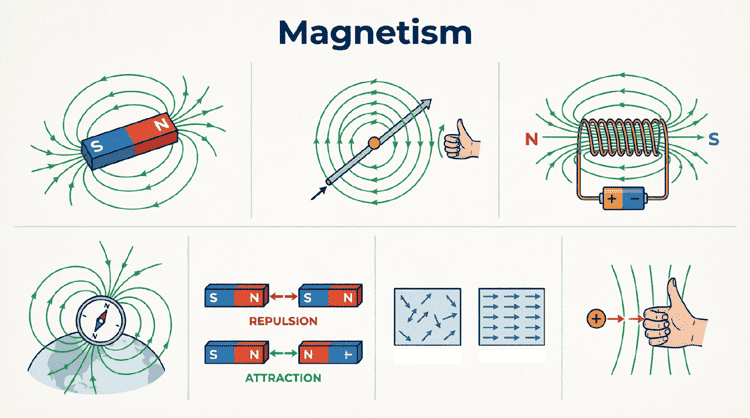
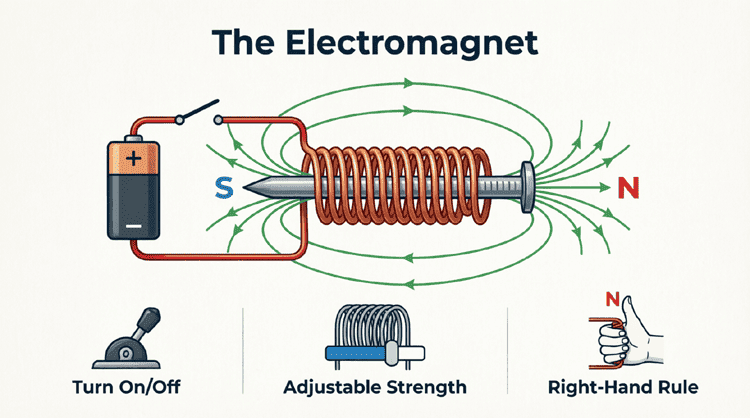
An electromagnet is a type of magnet in which the magnetic field is produced by an electric current. Unlike permanent magnets, which generate a constant magnetic field due to the alignment of their atomic structure, electromagnets offer something far more valuable: control. The magnetic field exists only when current flows, and its strength can be precisely adjusted by varying that current.
This controllability makes electromagnets indispensable in modern technology. From the massive electromagnets used in scrapyards to lift cars, to the microscopic electromagnets in your computer’s hard drive, these devices are everywhere. They form the heart of electric motors, generators, transformers, relays, magnetic resonance imaging (MRI) machines, and particle accelerators.
The basic principle is simple: wrap a wire around a core material (usually iron), pass an electric current through the wire, and you create a magnetic field. However, the engineering behind optimizing electromagnets for specific applications involves careful consideration of core materials, coil design, current density, and thermal management.
This comprehensive guide will explore the construction, operating principles, design factors, types, and practical applications of electromagnets, providing you with the knowledge to understand and design these essential electromagnetic devices.
What is an Electromagnet?
An electromagnet is a magnet created by passing electric current through a coil of wire wrapped around a ferromagnetic core (usually iron). The magnetic field exists only when current flows, and its strength can be controlled by adjusting the current. This makes electromagnets far more versatile than permanent magnets for most industrial and technological applications.
Construction and Working Principle
Basic Components
Every electromagnet consists of three fundamental components:
1. The Coil (Solenoid):
- Made of insulated copper or aluminum wire
- Wound in multiple turns (loops) around the core
- More turns = stronger magnetic field
- Wire gauge determines maximum current capacity
2. The Core:
- Typically made of soft iron or steel
- Concentrates and amplifies the magnetic field
- Can be removed (air core) for specific applications
- Material choice affects magnetic permeability and saturation
3. The Power Source:
- DC power supply (battery or rectified AC)
- Provides the current that generates the magnetic field
- Current magnitude directly controls field strength
How It Works
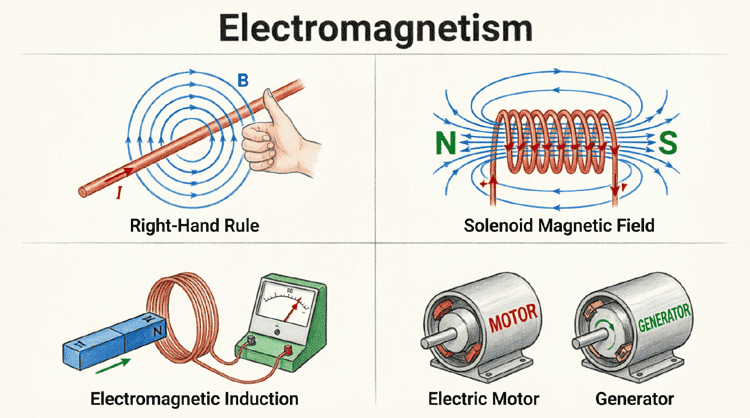
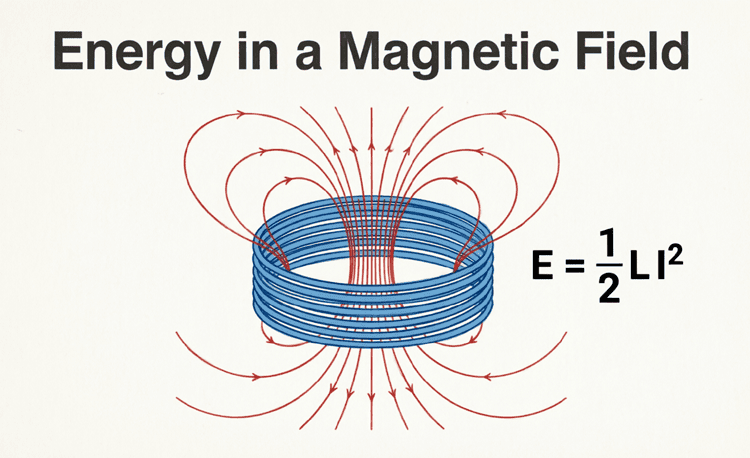
When electric current flows through the coiled wire, each loop generates a small circular magnetic field (as described by Ampere’s Law). These individual fields combine and reinforce each other inside the coil, creating a strong, uniform magnetic field along the axis of the solenoid.
The presence of a ferromagnetic core dramatically amplifies this effect. The core material has a much higher magnetic permeability (μ) than air—typically 200 to 5000 times higher for iron. This means the magnetic field lines prefer to travel through the iron rather than the surrounding air, concentrating the flux and creating a much stronger external field.
The Magnetic Circuit:
The electromagnet forms a magnetic circuit analogous to an electrical circuit:
- Magnetomotive Force (MMF) = $N \times I$ (Ampere-turns)
- Reluctance = Opposition to magnetic flux (like resistance)
- Flux = $MMF / Reluctance$ (like current)
Where:
- $N$ = Number of turns in the coil
- $I$ = Current in Amperes
Magnetic Field Strength Formula
The magnetic flux density ($B$) inside a long solenoid with a core is:
$B = \mu \cdot n \cdot I$
Where:
- $B$ = Magnetic flux density in Tesla (T)
- $\mu$ = Permeability of the core material ($\mu = \mu_0 \cdot \mu_r$)
- $n$ = Number of turns per unit length ($N/L$)
- $I$ = Current in Amperes
For an electromagnet with an iron core, the field strength can be thousands of times greater than an air-core solenoid with the same current and turns.
How does an electromagnet work?
An electromagnet works by passing electric current through a coil of wire, which generates a magnetic field. Wrapping the coil around a ferromagnetic core (like iron) concentrates and amplifies this field by thousands of times. The magnetic field disappears when the current stops, making it controllable.
Factors Affecting Electromagnet Strength
The strength of an electromagnet depends on several key design factors. Understanding these allows engineers to optimize electromagnets for specific applications.
1. Number of Turns (N)
Direct Relationship: More turns = Stronger field
Each loop of wire contributes to the total magnetic field. Doubling the number of turns (while keeping current constant) doubles the magnetic field strength.
Trade-off: More turns require more wire, increasing:
- Resistance (which limits current)
- Physical size
- Cost
- Heat generation
2. Current (I)
Direct Relationship: Higher current = Stronger field
Increasing the current flowing through the coil directly increases the magnetic field strength. This is often the easiest way to adjust field strength in real-time.
Limitations:
- Heating: $Power = I^2 \times R$ (Joule heating)
- Wire melting: Excessive current can melt insulation or the wire itself
- Power supply: Higher current requires larger, more expensive power supplies
3. Core Material (μ)
Critical Factor: Higher permeability = Much stronger field
The core material’s relative permeability ($\mu_r$) can amplify the magnetic field by factors of hundreds or thousands.
Common Core Materials:
| Material | Relative Permeability (μᵣ) | Saturation Flux (T) | Applications |
|---|---|---|---|
| Air | 1 | N/A | Specialized applications |
| Soft Iron | 200-5000 | 2.1 | General purpose electromagnets |
| Silicon Steel | 7000 | 2.0 | Transformers, motors |
| Ferrite | 20-15000 | 0.5 | High-frequency applications |
| Permalloy | 100000 | 0.8 | Sensitive instruments |
| Supermalloy | 1000000 | 0.7 | Ultra-sensitive detectors |
Saturation: Every material has a saturation point—the maximum magnetic flux density it can support. Beyond this point, increasing current produces little additional field strength. For iron, saturation occurs around 2.0-2.2 Tesla.
4. Core Geometry
Shape Matters:
- Closed magnetic circuits (toroidal cores) are most efficient
- Air gaps reduce field strength but allow mechanical movement
- Pole shape affects field concentration and uniformity
Length-to-Diameter Ratio:
Longer, thinner solenoids produce more uniform fields inside but weaker external fields. Shorter, fatter coils produce stronger external fields but less uniformity.
5. Wire Gauge and Resistance
Thicker wire:
- Lower resistance
- Can carry more current
- Takes up more space (fewer turns possible)
Thinner wire:
- Higher resistance
- Limited current capacity
- Allows more turns in same space
Designers must balance turns vs. current to achieve optimal field strength without overheating.
Types of Electromagnets
Electromagnets come in various configurations designed for specific applications.
1. Solenoid Electromagnets
Description: A simple coil of wire, often with a movable iron plunger inside.
Characteristics:
- Produces a uniform magnetic field inside the coil
- External field resembles a bar magnet
- Can be air-core or iron-core
Applications:
- Door locks (solenoid locks)
- Valves (solenoid valves)
- Relays and contactors
- Starter motors in vehicles
2. Toroidal Electromagnets
Description: Wire wound around a ring-shaped (toroidal) core.
Characteristics:
- Magnetic field is completely contained within the core
- Minimal external field (no stray fields)
- Highly efficient
- Compact design
Applications:
- Transformers
- Inductors in power supplies
- Current sensors (Rogowski coils)
- MRI gradient coils
3. Horseshoe Electromagnets
Description: U-shaped core with coils wound around both legs.
Characteristics:
- Creates a strong field between the poles
- Short air gap for maximum strength
- Easy to attach/detach objects
Applications:
- Scrapyard cranes
- Magnetic separators
- Lifting magnets
- Laboratory experiments
4. Flat Pole Electromagnets
Description: Cylindrical core with a flat pole face.
Characteristics:
- Concentrated field at the pole face
- Good for picking up flat objects
- Can be made very strong
Applications:
- Magnetic chucks (machine shops)
- Hard drive read/write heads
- Particle beam steering
- Magnetic resonance imaging
5. Superconducting Electromagnets
Description: Coils made from superconducting wire (zero resistance).
Characteristics:
- Can carry enormous currents without heating
- Produce extremely strong fields (10-20 Tesla)
- Require cryogenic cooling (liquid helium or nitrogen)
- Expensive but extremely powerful
Applications:
- MRI scanners (1.5-3 Tesla)
- Particle accelerators (LHC uses 8.3 Tesla magnets)
- Nuclear fusion reactors (tokamaks)
- Maglev trains
What are the main types of electromagnets?
The main types include: Solenoids (linear coils with plungers), Toroidal (ring-shaped, contained field), Horseshoe (U-shaped for lifting), Flat Pole (for concentrated fields), and Superconducting (extremely powerful, cryogenically cooled). Each type is optimized for specific applications.
Practical Applications of Electromagnets
Electromagnets are ubiquitous in modern technology. Here are some of the most important applications:
1. Electric Motors and Generators
Motors: Electromagnets on the rotor interact with permanent magnets or other electromagnets on the stator to create rotational torque. By switching the current direction (commutation), continuous rotation is achieved.
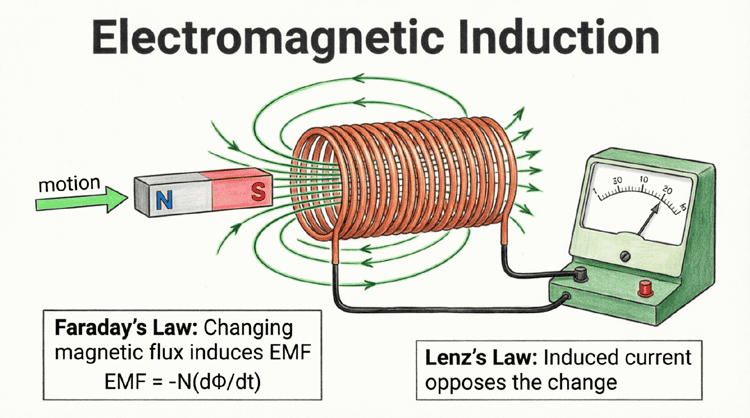
Generators: The reverse process—mechanical rotation moves conductors through magnetic fields, inducing current (Faraday’s Law).
2. Transformers
Transformers use two electromagnets (primary and secondary coils) wound around a common iron core. Alternating current in the primary creates a changing magnetic field, which induces voltage in the secondary. This allows efficient voltage conversion for power transmission.
3. Relays and Contactors
A relay is an electrically operated switch. A small control current energizes an electromagnet, which pulls a metal armature to close (or open) a separate, high-power circuit. This allows low-power circuits to control high-power loads safely.
4. Magnetic Resonance Imaging (MRI)
MRI scanners use massive superconducting electromagnets (typically 1.5-3 Tesla, or 15,000-30,000 Gauss) to align hydrogen nuclei in the body. Radio waves then perturb this alignment, and the resulting signals are used to create detailed internal images.
5. Particle Accelerators
Devices like the Large Hadron Collider (LHC) use thousands of powerful superconducting electromagnets to steer and focus particle beams traveling at nearly the speed of light. The magnetic fields bend the particle trajectories in circular paths.
6. Magnetic Levitation (Maglev) Trains
Electromagnets on the train and track create repulsive or attractive forces that lift the train above the rails, eliminating friction. Additional electromagnets propel the train forward, allowing speeds exceeding 600 km/h (373 mph).
7. Loudspeakers and Microphones
Loudspeakers: An audio signal (AC) flows through a voice coil suspended in a permanent magnetic field. The varying current creates varying Lorentz forces that move the coil and attached cone back and forth, producing sound.
Microphones: The reverse process—sound waves move a coil in a magnetic field, inducing a small current that represents the audio signal.
8. Data Storage
Hard disk drives use electromagnets in the read/write head to magnetize tiny regions of the spinning platter (writing data) and detect their magnetic orientation (reading data). Though SSDs are replacing HDDs, electromagnets remain crucial in many storage technologies.
9. Industrial Lifting and Separation
Massive electromagnets are used in scrapyards to lift and move ferrous metals. Magnetic separators remove iron contaminants from food, minerals, and recycled materials.
Practical Examples and Calculations
Example 1: Calculating Magnetic Field Strength
Problem: An electromagnet has 500 turns of wire wound around a soft iron core with relative permeability $\mu_r = 2000$. The coil is 10 cm long and carries a current of 2 A. Calculate the magnetic flux density inside the core.
Solution:
Given:
- $N = 500$ turns
- $L = 10 \text{ cm} = 0.1 \text{ m}$
- $I = 2 \text{ A}$
- $\mu_r = 2000$
- $\mu_0 = 4\pi \times 10^{-7} \text{ T·m/A}$
Step 1: Calculate turns per unit length
$n = \frac{N}{L} = \frac{500}{0.1} = 5000 \text{ turns/m}$
Step 2: Calculate permeability
$\mu = \mu_0 \cdot \mu_r = (4\pi \times 10^{-7}) \times 2000$
$\mu = 2.513 \times 10^{-3} \text{ T·m/A}$
Step 3: Calculate flux density
$B = \mu \cdot n \cdot I$
$B = (2.513 \times 10^{-3}) \times 5000 \times 2$
$B = 25.13 \text{ T}$
Note: This exceeds iron’s saturation point (~2.1 T), so in reality, the field would saturate at approximately 2.1 T.
Example 2: Calculating Magnetomotive Force
Problem: A relay coil has 800 turns and needs to produce a magnetomotive force (MMF) of 1200 Ampere-turns to close the contacts. What current is required?
Solution:
Given:
- $N = 800$ turns
- $MMF = 1200 \text{ AT}$
Formula:
$MMF = N \cdot I$
Calculation:
$1200 = 800 \cdot I$
$I = \frac{1200}{800}$
$I = 1.5 \text{ A}$
The coil requires 1.5 Amperes to operate the relay.
Example 3: Comparing Air-Core vs. Iron-Core
Problem: Compare the magnetic field strength of an air-core solenoid vs. an identical solenoid with a soft iron core ($\mu_r = 3000$). Both have 1000 turns/m and carry 0.5 A.
Solution:
Air-Core:
$B_{air} = \mu_0 \cdot n \cdot I$
$B_{air} = (4\pi \times 10^{-7}) \times 1000 \times 0.5$
$B_{air} = 6.28 \times 10^{-4} \text{ T} = 0.628 \text{ mT}$
Iron-Core:
$B_{iron} = \mu_0 \cdot \mu_r \cdot n \cdot I$
$B_{iron} = (4\pi \times 10^{-7}) \times 3000 \times 1000 \times 0.5$
$B_{iron} = 1.885 \text{ T}$
Amplification Factor:
$\frac{B_{iron}}{B_{air}} = \frac{1.885}{0.000628} = 3000$
Result: The iron core amplifies the magnetic field by a factor of 3000, demonstrating why cores are essential for practical electromagnets.
Electromagnets represent one of the most versatile and important applications of electromagnetism. By combining the magnetic field generated by electric current with the flux-concentrating properties of ferromagnetic materials, we can create powerful, controllable magnets that form the backbone of modern electrical technology.
Key takeaways from this guide:
- Construction: An electromagnet consists of a coil of wire (solenoid) wrapped around a ferromagnetic core, typically soft iron.
- Working Principle: Current flowing through the coil generates a magnetic field. The core concentrates and amplifies this field by its relative permeability ($\mu_r$).
- Strength Factors: Magnetic field strength depends on:
- Number of turns ($N$)
- Current ($I$)
- Core permeability ($\mu_r$)
- Core geometry and saturation limits
- Types: Solenoids, toroidal, horseshoe, flat pole, and superconducting electromagnets each serve specific applications.
- Applications: Electric motors, transformers, relays, MRI machines, particle accelerators, maglev trains, loudspeakers, and data storage devices all rely on electromagnets.
- Control: Unlike permanent magnets, electromagnets can be turned on/off and their strength adjusted by controlling the current.
- Saturation: Iron cores saturate around 2.0-2.2 Tesla, limiting maximum field strength regardless of current.
Understanding electromagnets is essential for anyone working with electrical machines, power systems, or electromagnetic devices. In the next article, we will explore Magnetic Hysteresis, examining why some materials retain magnetism after the current is removed and how this property affects the efficiency and performance of electromagnetic devices.