Energy in a Magnetic Field
Energy in a Magnetic Field: The Complete Guide to Magnetic Energy Storage
Introduction to Magnetic Field Energy
When we think of energy storage, we typically imagine batteries, capacitors, or mechanical springs. However, magnetic fields themselves are powerful reservoirs of energy. Every time current flows through an inductor, or a transformer transfers power between circuits, or a motor converts electrical energy to mechanical motion, energy is being temporarily stored in and released from magnetic fields.
Understanding energy in a magnetic field is crucial for designing efficient electrical systems. It explains why inductors resist changes in current, why transformers have leakage inductance, and why opening a switch in an inductive circuit can create dangerous voltage spikes (inductive kickback).
The energy stored in a magnetic field is not just a theoretical curiosity—it’s the fundamental principle behind:
- Inductors and chokes in power supplies
- Transformers for voltage conversion
- Electric motors and generators for energy conversion
- Magnetic energy storage systems (SMES)
- Wireless power transfer systems
This comprehensive guide will explore how magnetic fields store energy, the mathematical formulas for calculating magnetic energy, energy density concepts, and the practical applications that make modern electrical engineering possible.
What is Energy in a Magnetic Field?
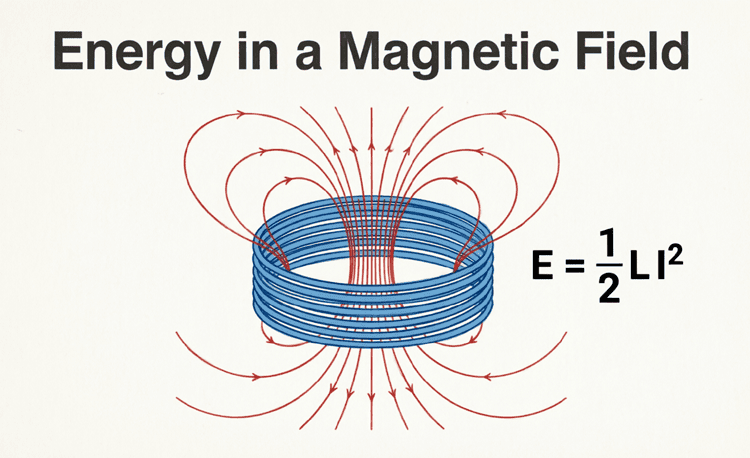
Energy in a magnetic field is the potential energy stored when work is done to establish a magnetic field, typically by driving current through an inductor. The energy stored is given by $W = \frac{1}{2}LI^2$ for an inductor, or $W = \frac{B^2}{2\mu} \times \text{Volume}$ for a magnetic field in space. This energy can be recovered when the field collapses.
How Magnetic Fields Store Energy
The Work Required to Establish a Field
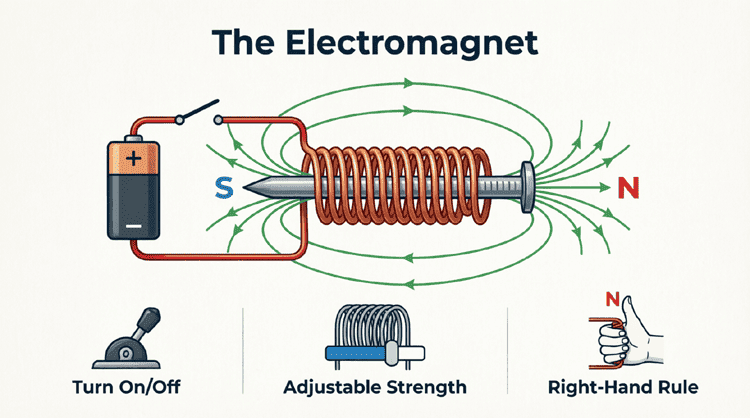
To understand why magnetic fields store energy, consider what happens when we try to establish current in an inductor (a coil of wire).
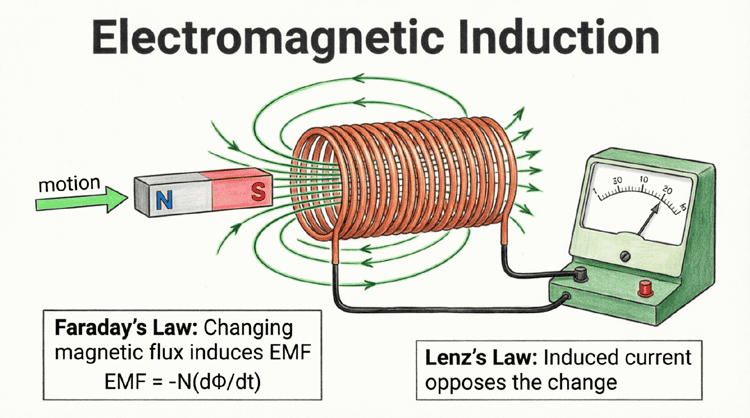
When we first connect a voltage source to an inductor, the current doesn’t instantly jump to its final value. Instead, it rises gradually. Why? Because as the current begins to flow, it creates a growing magnetic field. According to Faraday’s Law of Induction, this changing magnetic field induces a back EMF (electromotive force) that opposes the applied voltage (Lenz’s Law).
To overcome this opposition and increase the current, the voltage source must do work. This work doesn’t disappear—it is stored as potential energy in the magnetic field itself.
Once the current reaches a steady state (DC), the magnetic field is constant, no more work is required, and the energy remains stored in the field. If we then disconnect the source, the collapsing magnetic field releases this stored energy, often creating a voltage spike as it tries to maintain the current flow.
Analogy to Mechanical Systems
The energy storage in a magnetic field is analogous to:
- Kinetic energy in a moving mass: Just as a massive object resists changes in velocity (inertia), an inductor resists changes in current. Energy is stored in the motion ($KE = \frac{1}{2}mv^2$) just as it is in the magnetic field ($W = \frac{1}{2}LI^2$).
- Potential energy in a spring: Compressing a spring requires work, which is stored as potential energy. Similarly, “compressing” magnetic field lines (establishing a field) requires work.
Energy Stored in an Inductor
The most common and practical way to calculate magnetic energy is through the inductance of a coil.
Derivation of the Energy Formula
Consider an inductor with inductance L (Henrys). We gradually increase the current from 0 to a final value I.
At any instant, the voltage across the inductor is:
$v = L \frac{di}{dt}$
The instantaneous power being delivered to the inductor is:
$p = v \cdot i = L \cdot i \cdot \frac{di}{dt}$
The total work done (energy stored) is the integral of power over time:
$W = \int p \, dt = \int L \cdot i \cdot \frac{di}{dt} \, dt$
Since $\frac{di}{dt} \, dt = di$, we can rewrite this as an integral over current:
$W = \int_0^I L \cdot i \, di$
Assuming L is constant (linear inductor):
$W = L \int_0^I i \, di = L \left[ \frac{i^2}{2} \right]_0^I$
$W = \frac{1}{2} L I^2$
Where:
- $W$ = Energy stored in Joules (J)
- $L$ = Inductance in Henrys (H)
- $I$ = Final current in Amperes (A)
Key Characteristics of the Formula
- Proportional to Inductance: Doubling the inductance doubles the stored energy (for the same current).
- Proportional to Current Squared: Doubling the current quadruples the stored energy. This is why high-current inductors can store significant energy even with modest inductance.
- Always Positive: Energy is always positive (or zero), regardless of current direction, because $I^2$ is always positive.
- Recoverable: This energy can be returned to the circuit when the field collapses (though practical losses occur).
How do you calculate energy stored in an inductor?
The energy stored in an inductor is calculated using the formula $W = \frac{1}{2}LI^2$, where $L$ is the inductance in Henrys and $I$ is the current in Amperes. For example, a 10 mH inductor carrying 2 A stores $W = 0.5 \times 0.01 \times 4 = 0.02$ Joules (20 mJ).
Magnetic Energy Density
While the formula $W = \frac{1}{2}LI^2$ is useful for circuit analysis, it doesn’t tell us where the energy is located. The energy is actually distributed throughout the volume of the magnetic field itself.
Energy Density Formula
Energy density ($w$) is the energy stored per unit volume of the magnetic field:
$w = \frac{W}{V} = \frac{B^2}{2\mu}$
Or alternatively:
$w = \frac{1}{2} B \cdot H$
Where:
- $w$ = Energy density in Joules per cubic meter (J/m³)
- $B$ = Magnetic flux density in Tesla (T)
- $H$ = Magnetic field strength in Amperes per meter (A/m)
- $\mu$ = Permeability of the material ($\mu = \mu_0 \mu_r$)
- $V$ = Volume in cubic meters (m³)
Derivation for a Solenoid
Consider a long solenoid with:
- $N$ turns
- Length $l$
- Cross-sectional area $A$
- Current $I$
Magnetic field inside: $B = \mu \frac{N}{l} I$
Inductance: $L = \frac{\mu N^2 A}{l}$
Energy stored: $W = \frac{1}{2} L I^2 = \frac{1}{2} \left( \frac{\mu N^2 A}{l} \right) I^2$
Volume: $V = A \cdot l$
Energy density:
$w = \frac{W}{V} = \frac{\frac{1}{2} \mu N^2 A I^2 / l}{A \cdot l} = \frac{\mu N^2 I^2}{2 l^2}$
Since $B = \mu \frac{N}{l} I$, we have $B^2 = \mu^2 \frac{N^2}{l^2} I^2$
Therefore: $w = \frac{B^2}{2\mu}$
Key Insights from Energy Density
- Proportional to B²: Energy density increases with the square of the magnetic flux density. Doubling B quadruples the energy density.
- Inversely Proportional to μ: For the same B field, materials with higher permeability store less energy density. This is because high-μ materials concentrate the field more easily, requiring less energy to establish it.
- Location of Energy: The energy is distributed throughout the entire volume where the magnetic field exists, not just in the conductor or core material.
Total Energy in a Magnetic Field
To find the total energy stored in a magnetic field that varies in space, we integrate the energy density over the entire volume:
$W = \int_V w \, dV = \int_V \frac{B^2}{2\mu} \, dV$
For uniform fields, this simplifies to:
$W = \frac{B^2}{2\mu} \times V$
Example: Energy in an Air Gap
In magnetic circuits (like transformers and motors), energy is often concentrated in air gaps. Even though the gap volume is small, the energy density can be very high because air has low permeability ($\mu_0$).
Consider a magnetic circuit with:
- Air gap length: $g = 2 \text{ mm} = 0.002 \text{ m}$
- Cross-sectional area: $A = 10 \text{ cm}^2 = 0.001 \text{ m}^2$
- Flux density in gap: $B = 1.0 \text{ T}$
Volume of gap: $V = A \cdot g = 0.001 \times 0.002 = 2 \times 10^{-6} \text{ m}^3$
Energy density: $w = \frac{B^2}{2\mu_0} = \frac{1.0^2}{2 \times 4\pi \times 10^{-7}} = \frac{1}{2.513 \times 10^{-6}} \approx 398,000 \text{ J/m}^3$
Total energy: $W = w \times V = 398,000 \times 2 \times 10^{-6} \approx 0.796 \text{ J}$
Even in a tiny 2 mm gap, nearly 0.8 Joules of energy is stored!
Practical Applications of Magnetic Energy Storage
1. Inductors in Power Supplies
Inductors are fundamental components in switching power supplies (buck, boost, buck-boost converters). They store energy during the “on” phase of the switching cycle and release it during the “off” phase, smoothing the output voltage and enabling efficient voltage conversion.
Energy Transfer:
- Switch ON: Current builds in inductor, energy stored: $W = \frac{1}{2}LI^2$
- Switch OFF: Magnetic field collapses, energy transferred to load
2. Transformers
Transformers store energy in their magnetic fields during each AC cycle. The mutual inductance between primary and secondary windings allows energy to be transferred from one circuit to another without direct electrical connection.
Leakage Inductance: Not all magnetic flux links both windings. The “leakage” flux stores energy that doesn’t transfer to the secondary, causing voltage drops and limiting short-circuit current.
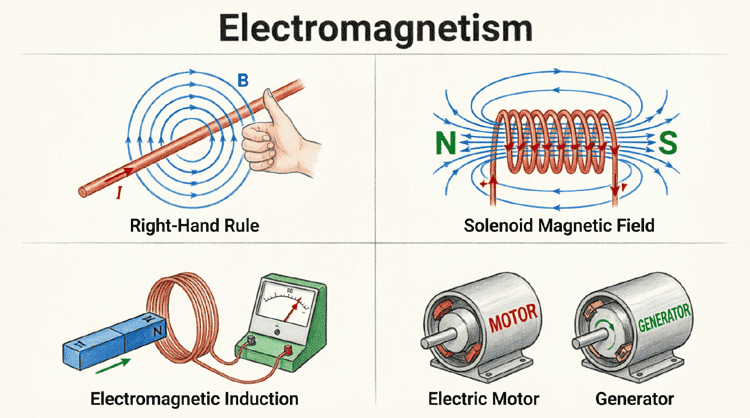
3. Electric Motors and Generators
In electric machines, energy is continuously converted between electrical and mechanical forms via magnetic fields:
- Motors: Electrical energy → Magnetic field energy → Mechanical energy
- Generators: Mechanical energy → Magnetic field energy → Electrical energy
The torque produced is directly related to the rate of change of magnetic energy with respect to rotor position.
4. Superconducting Magnetic Energy Storage (SMES)
SMES systems store large amounts of energy in the magnetic field created by DC current flowing through a superconducting coil. Because superconductors have zero resistance, the current (and thus the stored energy) can be maintained indefinitely without loss.
Advantages:
- Very fast response time (milliseconds)
- High efficiency (95-98%)
- Long cycle life
Applications: Grid stabilization, power quality improvement, pulsed power systems.
5. Inductive Kickback and Snubber Circuits
When current in an inductor is suddenly interrupted (e.g., opening a switch), the stored energy must go somewhere. Since $W = \frac{1}{2}LI^2$ and the current tries to continue flowing, a very high voltage spike ($V = L \frac{di}{dt}$) is generated.
This “inductive kickback” can:
- Damage switching components (transistors, relays)
- Create electromagnetic interference (EMI)
- Cause arcing across switch contacts
Solution: Snubber circuits (diodes, RC networks, or varistors) provide a safe path for the stored energy to dissipate.
Practical Examples and Calculations
Example 1: Energy Stored in an Inductor
Problem: A solenoid has an inductance of 50 mH. Calculate the energy stored when a current of 4 A flows through it.
Solution:
Given:
- $L = 50 \text{ mH} = 0.050 \text{ H}$
- $I = 4 \text{ A}$
Formula:
$W = \frac{1}{2} L I^2$
Calculation:
$W = \frac{1}{2} \times 0.050 \times 4^2$
$W = 0.025 \times 16$
$W = 0.4 \text{ Joules}$
Result: The inductor stores 0.4 Joules of energy.
Example 2: Energy Density in a Magnetic Field
Problem: A magnetic field of 1.5 T exists in a region filled with air. Calculate:
(a) The energy density
(b) The total energy if the field occupies a volume of 100 cm³
Solution:
Given:
- $B = 1.5 \text{ T}$
- $\mu = \mu_0 = 4\pi \times 10^{-7} \text{ H/m}$ (air)
- $V = 100 \text{ cm}^3 = 100 \times 10^{-6} \text{ m}^3 = 10^{-4} \text{ m}^3$
Part (a): Energy Density
Formula:
$w = \frac{B^2}{2\mu_0}$
Calculation:
$w = \frac{1.5^2}{2 \times 4\pi \times 10^{-7}}$
$w = \frac{2.25}{2.513 \times 10^{-6}}$
$w \approx 895,000 \text{ J/m}^3 = 895 \text{ kJ/m}^3$
Part (b): Total Energy
Formula:
$W = w \times V$
Calculation:
$W = 895,000 \times 10^{-4}$
$W = 89.5 \text{ Joules}$
Result: The energy density is 895 kJ/m³, and the total energy in 100 cm³ is 89.5 J.
Example 3: Comparing Energy in Air Gap vs. Iron Core
Problem: A magnetic circuit has an iron core ($\mu_r = 2000$) with an air gap. The flux density is uniform at 1.2 T in both regions. Compare the energy density in the air gap versus the iron core.
Solution:
Given:
- $B = 1.2 \text{ T}$ (same in both)
- $\mu_{air} = \mu_0$
- $\mu_{iron} = \mu_0 \mu_r = 2000 \mu_0$
Energy Density Formula:
$w = \frac{B^2}{2\mu}$
In Air Gap:
$w_{air} = \frac{1.2^2}{2\mu_0} = \frac{1.44}{2\mu_0} = \frac{0.72}{\mu_0}$
In Iron Core:
$w_{iron} = \frac{1.2^2}{2(2000\mu_0)} = \frac{1.44}{4000\mu_0} = \frac{0.00036}{\mu_0}$
Ratio:
$\frac{w_{air}}{w_{iron}} = \frac{0.72/\mu_0}{0.00036/\mu_0} = \frac{0.72}{0.00036} = 2000$
Result: The energy density in the air gap is 2000 times higher than in the iron core, even though the flux density is the same! This is why air gaps dominate the energy storage in magnetic circuits.
Energy in a magnetic field is a fundamental concept that bridges the gap between electrical and mechanical systems. Whether we’re designing a simple inductor, a complex transformer, or a high-efficiency electric motor, understanding how magnetic fields store and release energy is essential.
Key takeaways from this guide:
- Energy Storage Formula: The energy stored in an inductor is $W = \frac{1}{2}LI^2$. This energy is proportional to inductance and the square of the current.
- Energy Density: The energy is distributed throughout the magnetic field volume with density $w = \frac{B^2}{2\mu}$. Higher flux density means much higher energy density (quadratic relationship).
- Air Gaps Dominate: In magnetic circuits, most of the energy is stored in air gaps rather than the core material, because air has much lower permeability.
- Work is Required: Establishing a magnetic field requires work against the back EMF, and this work is stored as potential energy in the field.
- Applications: Magnetic energy storage is critical in inductors (power supplies), transformers (energy transfer), motors/generators (energy conversion), and SMES systems (grid storage).
- Inductive Kickback: When a magnetic field collapses suddenly, the stored energy can create dangerous voltage spikes, requiring protection circuits.
Understanding magnetic energy allows engineers to:
- Size inductors correctly for power conversion
- Design efficient transformers with minimal losses
- Predict and control voltage spikes in switching circuits
- Optimize motor and generator performance
- Develop advanced energy storage systems
As we continue to push the boundaries of electrical technology—from wireless power transfer to high-efficiency electric vehicles—the principles of magnetic energy storage remain as relevant today as when Faraday first discovered electromagnetic induction nearly 200 years ago.