Real-Time Clocks
Real-Time Clocks (RTC): The Complete Guide to Timekeeping in Embedded Systems
Introduction to Real-Time Clocks
A Real-Time Clock (RTC) is a specialized integrated circuit that keeps track of current time and date, even when the main system power is off. Unlike microcontroller timers that reset when power is lost, RTCs maintain accurate timekeeping through battery backup, making them essential for applications requiring persistent time information.
RTCs are ubiquitous in modern electronics:
- Computers and Servers: BIOS/UEFI timekeeping, file timestamps
- Embedded Systems: Data logging, scheduled operations, alarms
- IoT Devices: Time-stamped sensor data, scheduled communications
- Consumer Electronics: Digital clocks, watches, appliances
- Industrial Equipment: Event logging, maintenance scheduling
- Automotive: Trip computers, event data recorders
Understanding RTCs is crucial for:
- Implementing accurate timekeeping in embedded projects
- Selecting appropriate RTC ICs for specific applications
- Ensuring timekeeping accuracy and reliability
- Managing battery backup and power consumption
- Interfacing RTCs via I2C or SPI protocols
- Compensating for temperature drift and aging
This comprehensive guide explores RTC architecture, popular ICs, interfacing techniques, accuracy considerations, and practical implementation strategies for reliable timekeeping in embedded systems.
What is a Real-Time Clock (RTC)?
An RTC is a specialized IC that maintains accurate time and date information continuously, even when main power is removed, using a backup battery. It typically communicates via I2C or SPI and includes features like alarms, square-wave output, and temperature compensation for applications requiring persistent timekeeping.
RTC Architecture and Operation
Core Components
An RTC module consists of several critical components working together:
1. Timekeeping Circuitry:
- Binary-Coded Decimal (BCD) counters for seconds, minutes, hours, days, months, years
- Automatic calendar logic (leap years, month lengths)
- 12/24 hour format selection
- Day-of-week calculation
2. Oscillator:
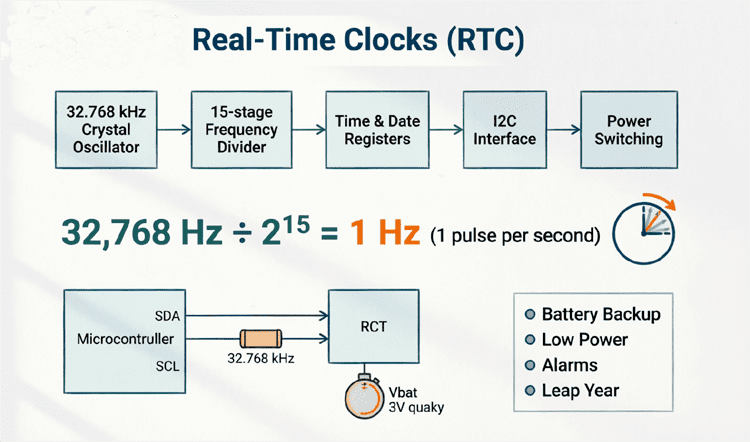
- 32.768 kHz crystal oscillator (standard)
- Provides precise timebase (2^15 = 32,768 Hz)
- Division chain converts to 1 Hz for seconds
- Accuracy: ±10-20 ppm typical
3. Backup Power System:
- Dedicated VBAT pin for battery backup
- Automatic switchover when main power fails
- Ultra-low current consumption (0.5-2 µA typical)
- Battery types: CR2032 coin cell, rechargeable Li-ion, supercapacitor
4. Interface Circuitry:
- I2C (most common): 2-wire interface (SDA, SCL)
- SPI alternative: 4-wire interface
- Address decoding for bus communication
- Level shifting for different voltage domains
5. Additional Features:
- Alarm registers (one or multiple)
- Square-wave output (configurable frequency)
- Temperature compensation (high-accuracy RTCs)
- Trimming registers for calibration
- Write protection
- Oscillator failure detection
How Timekeeping Works
Frequency Division Chain:
The 32.768 kHz crystal frequency is specifically chosen because it’s a power of 2:
$$32,768 = 2^{15}$$
This allows simple binary division:
- 32,768 Hz → 16,384 Hz (÷2)
- 16,384 Hz → 8,192 Hz (÷2)
- Continue dividing…
- 2 Hz → 1 Hz (1 second pulse)
The 1 Hz signal drives the seconds counter, which cascades to minutes, hours, days, etc.
BCD vs. Binary Representation:
Most RTCs use Binary-Coded Decimal (BCD) format for time registers:
- Binary: 0-59 seconds = 0000000 to 0111011 (7 bits)
- BCD: 0-59 seconds = 0000 0000 to 0101 1001 (two 4-bit digits)
BCD makes it easier to convert to decimal for display but requires conversion when reading/writing from microcontrollers.
Example:
- Time: 23 seconds
- Binary: 0001 0111 (0x17)
- BCD: 0010 0011 (0x23)
Why do RTCs use a 32.768 kHz crystal?
The 32.768 kHz frequency is exactly 2^15 Hz, allowing simple binary division by 2 fifteen times to get exactly 1 Hz (1 second). This makes the circuit simple, low-power, and accurate. It’s the industry standard for timekeeping applications.
Popular RTC Integrated Circuits
Several RTC ICs dominate the market, each with specific features and trade-offs. Understanding their characteristics helps in selecting the right RTC for your application.
DS1307: The Classic Choice
Manufacturer: Maxim Integrated (formerly Dallas Semiconductor)
Specifications:
- Interface: I2C (400 kHz fast mode)
- Supply voltage: 5V (main), 3V (backup)
- Current consumption: 1.5 µA (backup)
- Accuracy: ±2 ppm at 25°C (±120 ppm over temperature)
- Features: 56-byte battery-backed RAM, square-wave output
- Operating temperature: -40°C to +85°C
- Package: 8-pin DIP, SOIC
Advantages:
- Simple interface, widely supported
- Inexpensive (~$1-2)
- Large RAM for user data
- Extensive library support (Arduino, etc.)
Disadvantages:
- Requires external 32.768 kHz crystal
- Accuracy degrades with temperature
- 5V operation only (not 3.3V compatible without level shifting)
- No temperature compensation
Applications: General-purpose timekeeping, data loggers, simple clocks
DS3231: High-Accuracy RTC
Manufacturer: Maxim Integrated
Specifications:
- Interface: I2C (400 kHz)
- Supply voltage: 3.3V to 5V
- Current consumption: 200 µA (active), 3 µA (backup)
- Accuracy: ±2 ppm from 0°C to +40°C (±5 ppm from -40°C to +85°C)
- Features: Integrated crystal, temperature-compensated crystal oscillator (TCXO), two alarms, square-wave output, aging register
- Operating temperature: -40°C to +85°C
- Package: 16-pin SOIC
Advantages:
- Excellent accuracy (±2 ppm = ±1 minute per year!)
- Built-in crystal (no external components)
- Temperature compensation (TCXO)
- Wide voltage range (3.3V-5V)
- Battery-backed SRAM (236 bytes)
- Aging register for fine-tuning
Disadvantages:
- Higher cost (~$3-5)
- Higher current consumption than DS1307
- More complex register map
Applications: Precision timekeeping, GPS modules, data loggers requiring accuracy, industrial equipment
PCF8523: Low-Power Alternative
Manufacturer: NXP Semiconductors
Specifications:
- Interface: I2C (400 kHz)
- Supply voltage: 2.5V to 5.5V
- Current consumption: 230 nA (backup), 300 µA (active)
- Accuracy: ±3 ppm at 25°C (±20 ppm over temperature)
- Features: Programmable clock output, alarm, timer, watchdog, battery switchover
- Operating temperature: -40°C to +85°C
- Package: 8-pin TSSOP, HVQFN
Advantages:
- Ultra-low power consumption
- Wide voltage range
- Multiple alarm/timer modes
- Automatic battery switchover
- Programmable output frequencies
- Low cost (~$1-2)
Disadvantages:
- Requires external crystal
- Less accurate than DS3231
- Smaller community support
Applications: Battery-powered devices, IoT sensors, wearables, portable equipment
MCP7940N: Feature-Rich RTC
Manufacturer: Microchip Technology
Specifications:
- Interface: I2C (1 MHz high-speed)
- Supply voltage: 1.8V to 5.5V
- Current consumption: 1.2 µA (backup), 25 µA (active)
- Accuracy: ±25 ppm at 25°C
- Features: 64-byte SRAM, unique ID, programmable output, power-fail timestamp
- Operating temperature: -40°C to +85°C
- Package: 8-pin MSOP, DFN
Advantages:
- Very wide voltage range (1.8V-5.5V)
- Unique ID for device identification
- Power-fail timestamp (records when power was lost)
- High-speed I2C (1 MHz)
- Low cost
Disadvantages:
- Requires external crystal
- Moderate accuracy
- Less common than DS1307/DS3231
Applications: Multi-voltage systems, device authentication, power monitoring
Comparison Table
| Feature | DS1307 | DS3231 | PCF8523 | MCP7940N |
|---|---|---|---|---|
| Interface | I2C | I2C | I2C | I2C |
| Voltage | 5V | 3.3-5V | 2.5-5.5V | 1.8-5.5V |
| Accuracy | ±120 ppm | ±2 ppm | ±20 ppm | ±25 ppm |
| Crystal | External | Integrated | External | External |
| Temp Comp | No | Yes (TCXO) | No | No |
| Backup Current | 1.5 µA | 3 µA | 230 nA | 1.2 µA |
| SRAM | 56 bytes | 236 bytes | None | 64 bytes |
| Cost | $ | $$ | $ | $ |
| Best For | General use | Precision | Low power | Wide voltage |
Which RTC should I use?
For most applications: DS3231 (best accuracy, integrated crystal). For battery-powered devices: PCF8523 (ultra-low power). For simple projects on a budget: DS1307 (cheap, simple). For wide voltage range: MCP7940N (1.8V-5.5V).
Battery Backup and Power Management
One of the defining features of RTCs is their ability to maintain timekeeping when main power is removed. This requires careful attention to battery backup design.
Battery Types
1. Lithium Coin Cells (Most Common):
- CR2032: 3V, 220 mAh, 20mm diameter
- Most popular choice
- 3-5 year lifespan at 1-3 µA draw
- Readily available, inexpensive
- CR2025: 3V, 165 mAh, 20mm diameter (thinner)
- CR2450: 3V, 620 mAh, 24mm diameter (higher capacity)
2. Rechargeable Batteries:
- LIR2032: 3.6V rechargeable Li-ion
- Can be charged from main supply
- Lower capacity (~40 mAh)
- Requires charging circuit
- Supercapacitors: 2.5V-5.5V, 0.1F-1F
- Very long life (10+ years)
- Fast charging
- Higher self-discharge
- Good for frequent power cycles
3. Primary Lithium:
- BR2330: 3V, 260 mAh
- Higher temperature range
- Lower self-discharge than CR series
Battery Switchover Circuits
RTCs include automatic battery switchover circuitry:
Operation:
- Main power (VCC) present: RTC powered from VCC, battery isolated
- Main power fails: Automatic switchover to VBAT (battery)
- Main power restored: Switchover back to VCC, battery re-isolated
Key Considerations:
Diode OR-ing (Simple):
VCC ----|<|----+---- VRTC
                   |
VBAT ---|<|----+- Simple but voltage drop (0.3-0.7V)
- Wastes battery voltage
MOSFET Switchover (Efficient):
- Near-zero voltage drop
- More complex
- Used in modern RTCs
Battery Current Calculation:
$$\text{Battery Life (hours)} = \frac{\text{Battery Capacity (mAh)}}{\text{RTC Current (mA)}}$$
Example: CR2032 (220 mAh) with DS1307 (1.5 µA):
$$\text{Life} = \frac{220 \text{ mAh}}{0.0015 \text{ mA}} = 146,667 \text{ hours} \approx 16.7 \text{ years}$$
In practice: 5-10 years due to self-discharge and temperature effects.
Power-Saving Techniques
1. Reduce RTC Current:
- Choose low-power RTC (PCF8523: 230 nA)
- Disable unnecessary features (square-wave output)
- Use sleep modes when possible
2. Optimize Battery:
- Use high-capacity cells (CR2450 vs CR2032)
- Store at cool temperatures (reduces self-discharge)
- Use fresh batteries (check manufacture date)
3. Monitor Battery:
- Implement battery voltage monitoring
- Alert when battery is low
- Schedule battery replacement
How long will an RTC battery last?
A CR2032 coin cell (220 mAh) powering a DS1307 (1.5 µA) can theoretically last 16+ years. In practice, expect 5-10 years due to battery self-discharge and temperature effects. Low-power RTCs like PCF8523 (230 nA) can extend this significantly.
Interfacing RTCs with Microcontrollers
Most modern RTCs use I2C communication, making interfacing straightforward. Here’s how to connect and communicate with an RTC.
I2C Connection
Wiring (Example: DS3231 with Arduino):
DS3231          Arduino
--------        -------
VCC      -----> 5V or 3.3V
GND      -----> GND
SDA      -----> A4 (SDA)
SCL      -----> A5 (SCL)
SQW      -----> (optional) interrupt pin
Pull-up Resistors:
- I2C requires pull-up resistors on SDA and SCL
- Typical values: 4.7kΩ to 10kΩ
- Most modules include these; check before adding
I2C Addresses:
- DS1307: 0x68
- DS3231: 0x68
- PCF8523: 0x68
- MCP7940N: 0x6F
Note: Many RTCs use the same address (0x68); you can only use one per I2C bus unless they have address selection pins.
Reading and Writing Time
BCD Conversion:
Most RTCs store time in BCD format. You need conversion functions:
// Convert decimal to BCD
uint8_t decToBCD(uint8_t val) {
  return ((val / 10) * 16) + (val % 10);
}

// Convert BCD to decimal
uint8_t bcdToDec(uint8_t val) {
  return ((val / 16) * 10) + (val % 16);
}
Writing Time to RTC:
void setTime(int hour, int minute, int second) {
  Wire.beginTransmission(0x68);  // DS3231 address
  Wire.write(0x00);               // Start at seconds register
  Wire.write(decToBCD(second));
  Wire.write(decToBCD(minute));
  Wire.write(decToBCD(hour));
  Wire.endTransmission();
}
Reading Time from RTC:
void getTime(int &hour, int &minute, int &second) {
  Wire.beginTransmission(0x68);
  Wire.write(0x00);               // Start at seconds register
  Wire.endTransmission();

  Wire.requestFrom(0x68, 3);      // Request 3 bytes
  second = bcdToDec(Wire.read() & 0x7F);  // Mask CH bit
  minute = bcdToDec(Wire.read());
  hour = bcdToDec(Wire.read() & 0x3F);    // Mask 12/24 bit
}
Using Libraries
For most applications, use established libraries rather than writing low-level code:
Arduino Libraries:
- RTClib (Adafruit):
- Supports DS1307, DS3231, PCF8523
- Simple API
- Well-documented
   #include <RTClib.h>
   RTC_DS3231 rtc;

   void setup() {
     rtc.begin();
     rtc.adjust(DateTime(F(__DATE__), F(__TIME__)));
   }

   DateTime now = rtc.now();
Serial.print(now.hour());- TimeLib:
- Time management library
- Works with various RTCs
- Provides time zone support
- DS3231 (Eric Ayars):
- DS3231-specific
- Advanced features (alarms, temperature)
Python (Raspberry Pi):
import smbus2
import datetime

class DS3231:
    def __init__(self, bus_num=1):
        self.bus = smbus2.SMBus(bus_num)
        self.address = 0x68

    def read_time(self):
        data = self.bus.read_i2c_block_data(self.address, 0, 7)
        # Convert BCD to decimal
        second = ((data[0] & 0x7F) >> 4) * 10 + (data[0] & 0x0F)
        minute = ((data[1] & 0x7F) >> 4) * 10 + (data[1] & 0x0F)
        hour = ((data[2] & 0x3F) >> 4) * 10 + (data[2] & 0x0F)
        return datetime.time(hour, minute, second)
Accuracy and Temperature Compensation
RTC accuracy is critical for many applications. Understanding what affects accuracy and how to compensate is essential.
Factors Affecting Accuracy
1. Crystal Frequency Tolerance:
- Standard crystals: ±20 ppm
- Tuning fork crystals (32.768 kHz): ±10-20 ppm
- Temperature-compensated (TCXO): ±0.5-5 ppm
2. Temperature Drift:
- 32.768 kHz crystals have parabolic temperature coefficient
- Typical drift: -0.04 ppm/°C²
- Maximum accuracy at 25°C
- Drift increases at temperature extremes
Formula:
$$\Delta f = -0.04 \times (T – 25)^2 \text{ ppm}$$
At 0°C or 50°C:
$$\Delta f = -0.04 \times (25)^2 = -25 \text{ ppm}$$
This equals ~2 seconds/day error!
3. Aging:
- Crystals drift over time
- Typical aging: ±3-5 ppm/year
- Decreases after first year
4. Load Capacitance:
- Crystal frequency depends on load capacitance
- Mismatch causes frequency error
- Follow datasheet recommendations
Temperature Compensation
DS3231 TCXO:
The DS3231 includes a built-in temperature-compensated crystal oscillator:
- Internal temperature sensor measures crystal temperature
- Compensation circuitry adjusts frequency
- Achieves ±2 ppm accuracy over temperature
- No external components needed
Software Compensation:
For RTCs without TCXO, you can implement software compensation:
- Measure temperature (external sensor or DS3231 internal)
- Calculate frequency error using crystal formula
- Adjust RTC by adding/subtracting seconds periodically
// Example compensation for DS1307
float temperature = readTemperature();  // °C
float drift = -0.04 * pow(temperature - 25, 2);  // ppm
float error_per_day = drift * 86400 / 1000000;  // seconds/day

// Adjust RTC periodically
if (error_per_day > 1.0) {
  adjustRTCSeconds(-1);  // Subtract 1 second
}
Trimming Registers:
Some RTCs (DS3231, PCF8523) include trimming registers:
- Fine-tune frequency in small increments
- DS3231: Aging register (±2 ppm resolution)
- PCF8523: Offset register (±4.3 ppm resolution)
Calibration Procedure:
- Set RTC to accurate time source (GPS, NTP)
- Wait 24-48 hours
- Measure time error
- Calculate required trim value
- Write to trim register
- Repeat until accurate
Achieving Best Accuracy
Best Practices:
- Use TCXO RTC: DS3231 for ±2 ppm accuracy
- Stable Temperature: Keep RTC at constant temperature
- Quality Crystal: If external, use ±10 ppm crystal
- Proper Layout: Minimize noise, proper grounding
- Regular Calibration: Calibrate against reference
- Aging Compensation: Account for crystal aging
Accuracy Comparison:
| RTC Type | Accuracy | Error per Day | Error per Year |
|---|---|---|---|
| DS1307 (no comp) | ±120 ppm | ±10 seconds | ±1 hour |
| DS3231 (TCXO) | ±2 ppm | ±0.17 seconds | ±1 minute |
| GPS-disciplined | ±0.001 ppm | ±0.0001 seconds | ±30 seconds |
Practical Applications and Examples
Data Logging
Scenario: Environmental sensor logging temperature every hour with timestamp.
#include <RTClib.h>
#include <SD.h>

RTC_DS3231 rtc;
File dataFile;

void setup() {
  rtc.begin();
  SD.begin(4);

  // Log header
  dataFile = SD.open("datalog.csv", FILE_WRITE);
  dataFile.println("Timestamp,Temperature,Humidity");
  dataFile.close();
}

void loop() {
  DateTime now = rtc.now();

  // Read sensors
  float temp = readTemperature();
  float humid = readHumidity();

  // Create timestamp
  char timestamp[30];
  sprintf(timestamp, "%04d-%02d-%02d %02d:%02d:%02d",
          now.year(), now.month(), now.day(),
          now.hour(), now.minute(), now.second());

  // Log to SD card
  dataFile = SD.open("datalog.csv", FILE_WRITE);
  dataFile.print(timestamp);
  dataFile.print(",");
  dataFile.print(temp);
  dataFile.print(",");
  dataFile.println(humid);
  dataFile.close();

  delay(3600000);  // 1 hour
}
Alarm Functions
Scenario: Wake microcontroller from sleep at scheduled times.
#include <RTClib.h>

RTC_DS3231 rtc;

void setup() {
  rtc.begin();

  // Set alarm for 8:00 AM every day
  rtc.setAlarm1(DateTime(2024, 1, 1, 8, 0, 0), DS3231_A1_Day);
  rtc.alarmInterrupt(1, true);

  // Enable interrupt pin
  pinMode(2, INPUT_PULLUP);
  attachInterrupt(digitalPinToInterrupt(2), wakeUp, FALLING);

  // Enter sleep mode
  enterSleepMode();
}

void wakeUp() {
  // Handle alarm event
  rtc.clearAlarm(1);
  performScheduledTask();
}
Time Synchronization
Scenario: Sync RTC with NTP server via WiFi.
#include <WiFi.h>
#include <NTPClient.h>
#include <RTClib.h>

RTC_DS3231 rtc;
WiFiUDP ntpUDP;
NTPClient timeClient(ntpUDP, "pool.ntp.org", 0, 86400000);

void setup() {
  rtc.begin();
  WiFi.begin("SSID", "PASSWORD");
  timeClient.begin();

  // Sync once per day
  if (shouldSync()) {
    timeClient.update();
    unsigned long epoch = timeClient.getEpochTime();
    rtc.adjust(DateTime(epoch));
  }
}
Real-Time Clocks are essential components for any embedded system requiring persistent, accurate timekeeping. From simple data loggers to complex industrial control systems, RTCs provide the temporal foundation for scheduling, timestamping, and time-sensitive operations.
Key takeaways from this guide:
- RTC Selection: Choose based on accuracy requirements (DS3231 for precision, PCF8523 for low power), voltage range, and budget
- Battery Backup: CR2032 coin cells provide 5-10 years of backup; calculate current consumption and choose appropriate capacity
- Accuracy: Temperature compensation is critical; DS3231’s TCXO achieves ±2 ppm (±1 minute/year) without external components
- Interfacing: I2C is standard; use libraries like RTClib for simplicity; handle BCD conversion properly
- Applications: Data logging, alarms, scheduled operations, time synchronization all benefit from reliable RTC implementation
- Best Practices: Use quality crystals, implement temperature compensation, calibrate regularly, monitor battery voltage
Whether you’re building a simple clock or a complex distributed sensor network, understanding RTC fundamentals ensures reliable, accurate timekeeping that forms the backbone of time-sensitive embedded applications.