Magnetism
Magnetism: The Complete Guide to Magnetic Fields and Properties
Introduction to Magnetism
Magnetism is one of the fundamental forces of nature, playing a crucial role in everything from compass navigation to electric motors, generators, and modern data storage devices. This invisible force surrounds us constantly, yet its principles govern much of our modern electrical and electronic technology.
Understanding magnetism is essential for anyone studying electrical engineering, physics, or related fields. From the simple bar magnet to complex electromagnetic systems, magnetic phenomena are integral to how we generate, transmit, and utilize electrical energy.
This comprehensive guide will explore the fundamental concepts of magnetism, including magnetic fields, poles, flux, material properties, and practical applications that form the foundation for understanding electromagnetism and electrical machines.
What is Magnetism?
Magnetism is a physical phenomenon produced by the motion of electric charge, resulting in attractive and repulsive forces between objects. It is mediated by magnetic fields that exert forces on moving electric charges and magnetic materials. All magnets have two poles (north and south), and like poles repel while opposite poles attract.
What is Magnetism?
The Nature of Magnetic Forces
Magnetism is a class of physical phenomena that are mediated by magnetic fields. These fields are generated by electric currents and the intrinsic magnetic moments of elementary particles (such as electrons).
Key Characteristics:
- Magnetic forces act on moving electric charges
- Magnetic fields have both magnitude and direction
- Magnetic poles always exist in pairs (north and south)
- Magnetic field lines form closed loops
- Magnetic forces can do no work directly (they act perpendicular to motion)
Historical Background
The study of magnetism dates back to ancient civilizations:
- 600 BC: Greeks discovered lodestone (magnetite), a naturally magnetic mineral
- 1000 AD: Chinese invented the magnetic compass for navigation
- 1820: Hans Christian Ørsted discovered that electric currents create magnetic fields
- 1831: Michael Faraday discovered electromagnetic induction
These discoveries laid the foundation for our modern understanding of electromagnetism.
Magnetic Fields and Field Lines
Understanding Magnetic Fields
A magnetic field is a vector field that describes the magnetic influence on moving electric charges, electric currents, and magnetic materials. It is denoted by the symbol B and measured in Tesla (T) or Gauss (G).
1 Tesla = 10,000 Gauss
Magnetic Field Lines
Magnetic field lines are imaginary lines used to visualize magnetic fields:
Properties of Magnetic Field Lines:
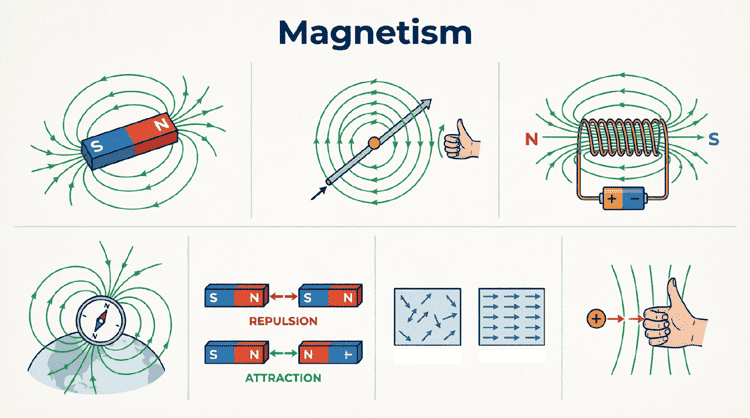
- Direction: Lines emerge from the north pole and enter the south pole
- Density: Closer lines indicate stronger magnetic fields
- Continuity: Lines form closed loops (no beginning or end)
- Non-intersection: Field lines never cross each other
- Repulsion: Parallel lines traveling in the same direction repel each other
Visualizing Field Patterns
Bar Magnet:
- Field lines emerge from north pole
- Curve around the magnet
- Enter the south pole
- Continue through the magnet back to north pole
Earth’s Magnetic Field:
- Similar to a giant bar magnet
- Magnetic north pole is actually a south magnetic pole (attracts north pole of compass)
- Protects Earth from solar wind
What are magnetic field lines?
Magnetic field lines are imaginary lines that represent the direction and strength of a magnetic field. They emerge from the north pole, curve through space, and enter the south pole, forming continuous closed loops. The density of lines indicates field strength—closer lines mean a stronger field.
Magnetic Poles and Their Properties
North and South Poles
Every magnet has two distinct poles:
- North Pole (N): The end that points toward Earth’s geographic north
- South Pole (S): The end that points toward Earth’s geographic south
Fundamental Laws of Magnetic Poles
Law of Magnetic Poles:
- Like poles repel: North repels north; south repels south
- Opposite poles attract: North attracts south
- Poles exist in pairs: Isolated magnetic poles (monopoles) have never been observed
Force Between Poles:
The force between two magnetic poles is given by Coulomb’s Law for magnetism:
$F = \frac{\mu_0 m_1 m_2}{4\pi r^2}$
Where:
- F = Force in Newtons (N)
- m₁, m₂ = Pole strengths in Ampere-meters (A·m)
- r = Distance between poles in meters (m)
- μ₀ = Permeability of free space = 4π × 10⁻ H/m
Magnetic Dipole
A magnet with two poles is called a magnetic dipole. The magnetic moment (m) is a vector quantity that measures the strength and orientation of a magnet:
$m = p \times l$
Where:
- p = Pole strength
- l = Distance between poles (magnetic length)
Magnetic Flux and Flux Density
Magnetic Flux (Φ)
Magnetic flux is the measure of the total magnetic field passing through a given area. It is denoted by the Greek letter Φ (phi) and measured in Webers (Wb).
Definition:
Magnetic flux through a surface is the product of:
- The average magnetic field strength
- The area perpendicular to the field
- The cosine of the angle between field and normal to surface
Formula:
$\Phi = B \cdot A \cdot \cos(\theta)$
Where:
- Φ = Magnetic flux in Webers (Wb)
- B = Magnetic flux density in Tesla (T)
- A = Area in square meters (m²)
- θ = Angle between field and normal to surface
Magnetic Flux Density (B)
Magnetic flux density (also called magnetic field strength or magnetic induction) is the amount of magnetic flux per unit area perpendicular to the field.
Formula:
$B = \frac{\Phi}{A}$ (when field is perpendicular to area)
Units:
- Tesla (T) = 1 Weber/m²
- Gauss (G) = 1 Maxwell/cm²
- 1 T = 10,000 G
Typical Values:
- Earth’s magnetic field: 25-65 μT (0.25-0.65 G)
- Refrigerator magnet: 5 mT (50 G)
- MRI scanner: 1.5-3 T (15,000-30,000 G)
- Strong laboratory magnet: 10-45 T
What is magnetic flux?
Magnetic flux (Φ) is the measure of the total magnetic field passing through a given area, measured in Webers (Wb). It is calculated as Φ = B × A × cos(θ), where B is magnetic flux density, A is area, and θ is the angle between the field and the surface normal.
Magnetic Materials and Their Properties
Classification of Magnetic Materials
Materials respond differently to magnetic fields and are classified into three main categories:
1. Diamagnetic Materials
Characteristics:
- Weakly repelled by magnetic fields
- Create an opposing magnetic field
- Relative permeability μᵣ < 1 (slightly less than 1)
- Effect is very weak and temporary
Examples:
- Copper
- Silver
- Gold
- Bismuth
- Water
- Most organic materials
Applications:
- Magnetic levitation (superconductors exhibit perfect diamagnetism)
- Magnetic shielding
2. Paramagnetic Materials
Characteristics:
- Weakly attracted to magnetic fields
- Align with the applied field
- Relative permeability μᵣ > 1 (slightly greater than 1)
- Effect is weak and temporary (disappears when field is removed)
Examples:
- Aluminum
- Platinum
- Oxygen
- Titanium
- Sodium
Applications:
- Magnetic resonance imaging (MRI) contrast agents
- Oxygen sensors
3. Ferromagnetic Materials
Characteristics:
- Strongly attracted to magnetic fields
- Can become permanently magnetized
- Relative permeability μᵣ >> 1 (much greater than 1, typically 100-100,000)
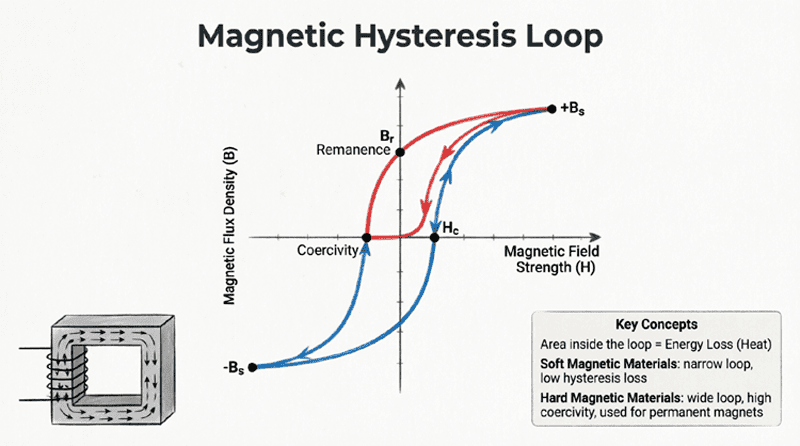
- Exhibit hysteresis (retain magnetization after field is removed)
- Have a Curie temperature above which they lose ferromagnetic properties
Examples:
- Iron (most common)
- Nickel
- Cobalt
- Steel (iron alloy)
- Ferrites (ceramic compounds)
Applications:
- Permanent magnets
- Transformer cores
- Electric motors and generators
- Magnetic storage (hard drives)
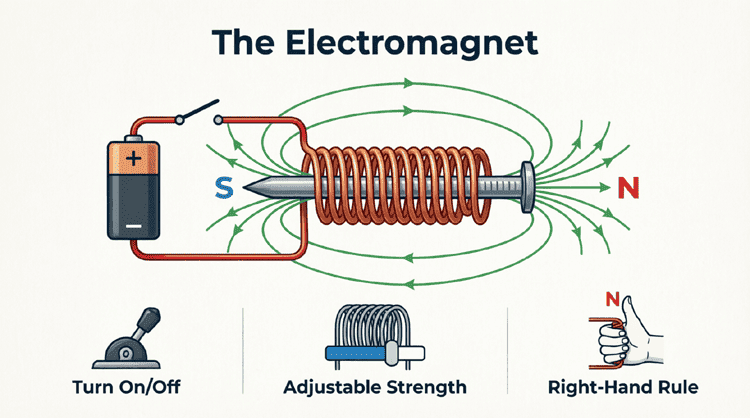
- Electromagnets
Magnetic Domains
In ferromagnetic materials, atomic magnetic moments align in small regions called magnetic domains:
Unmagnetized State:
- Domains are randomly oriented
- Net magnetic field is zero
- Material shows no external magnetism
Magnetized State:
- Domains align in the direction of applied field
- Net magnetic field is produced
- Material exhibits external magnetism
Saturation:
- All domains are aligned
- Maximum magnetization achieved
- Further increase in field produces no additional magnetization
Permeability and Reluctance
Permeability (μ)
Permeability is a measure of a material’s ability to support the formation of a magnetic field within itself. It indicates how easily magnetic flux can pass through a material.
Absolute Permeability:
$\mu = \mu_0 \mu_r$
Where:
- μ = Absolute permeability of material (H/m)
- μ₀ = Permeability of free space = 4π × 10⁻⁷ H/m ≈ 1.257 × 10⁻⁶ H/m
- μ = Relative permeability (dimensionless)
Relative Permeability Values:
- Vacuum/air: μᵣ = 1
- Diamagnetic: μᵣ < 1 (e.g., copper: 0.999994)
- Paramagnetic: μ > 1 (e.g., aluminum: 1.000022)
- Ferromagnetic: μᵣ >> 1 (e.g., iron: 200-5000, specialized alloys: up to 100,000)
Reluctance (ℛ)
Reluctance is the opposition offered by a material to the establishment of magnetic flux. It is analogous to resistance in electrical circuits.
Formula:
$\mathcal{R} = \frac{l}{\mu A} = \frac{l}{\mu_0 \mu_r A}$
Where:
- ℛ = Reluctance in Ampere-turns/Weber (AT/Wb)
- l = Length of magnetic path in meters (m)
- A = Cross-sectional area in m²
- μ = Permeability of material
Key Points:
- Higher permeability → Lower reluctance
- Longer path → Higher reluctance
- Larger area → Lower reluctance
Magnetic Circuit Analogy
Magnetic circuits follow laws similar to electrical circuits:
| Electrical Circuit | Magnetic Circuit |
|---|---|
| Current (I) | Flux (Φ) |
| Voltage (V) | Magnetomotive Force (MMF) |
| Resistance (R) | Reluctance (ℛ) |
| Ohm’s Law: I = V/R | Hopkinson’s Law: Φ = MMF/ℛ |
Magnetomotive Force (MMF):
$F_m = N \cdot I$
Where:
- F_m = MMF in Ampere-turns (AT)
- N = Number of turns
- I = Current in Amperes
What is permeability?
Permeability (μ) is a measure of a material’s ability to support the formation of a magnetic field within itself. It is the product of the permeability of free space (μ₀) and relative permeability (μ). High permeability materials like iron allow magnetic flux to pass through easily, while low permeability materials resist magnetic flux.
Practical Applications of Magnetism
1. Navigation and Compasses
The Earth’s magnetic field has been used for navigation for over 1000 years:
- Magnetic compass aligns with Earth’s field
- Points toward magnetic north
- Essential for maritime and land navigation
2. Electric Motors and Generators
Motors: Convert electrical energy to mechanical energy
- Use magnetic fields to produce torque
- Found in appliances, vehicles, industrial machinery
Generators: Convert mechanical energy to electrical energy
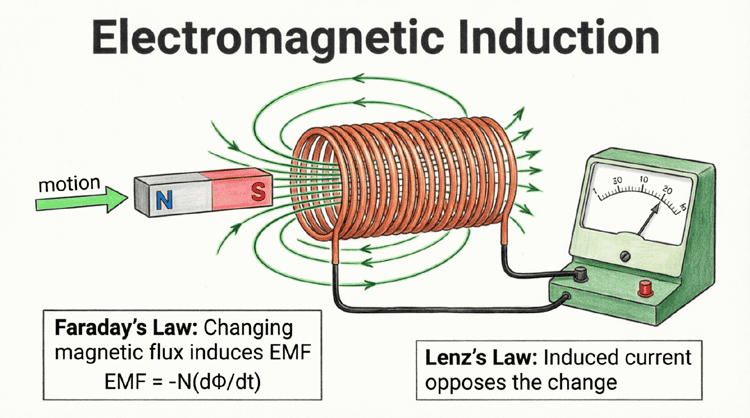
- Use motion through magnetic fields to induce voltage
- Power plants, alternators, dynamos
3. Transformers
- Transfer electrical energy between circuits
- Use magnetic coupling through iron cores
- Step up or step down voltages
- Essential for power distribution
4. Magnetic Storage
- Hard disk drives use magnetic domains to store data
- Magnetic tape for backup and archival
- Credit card strips
- Emerging: MRAM (Magnetoresistive RAM)
5. Medical Applications
MRI (Magnetic Resonance Imaging):
- Uses strong magnetic fields (1.5-3 Tesla)
- Non-invasive medical imaging
- Detailed images of soft tissues
Other Applications:
- Magnetic separators in mining
- Magnetic brakes in trains
- Loudspeakers and microphones
- Magnetic sensors
Practical Examples and Calculations
Example 1: Calculating Magnetic Flux
Problem: A uniform magnetic field of 0.5 T passes through a rectangular loop with dimensions 10 cm × 15 cm. Calculate the magnetic flux when:
(a) The field is perpendicular to the loop
(b) The field makes a 60° angle with the normal to the loop
Solution:
Given:
- B = 0.5 T
- Length = 10 cm = 0.1 m
- Width = 15 cm = 0.15 m
- Area A = 0.1 × 0.15 = 0.015 m²
(a) Perpendicular field (θ = 0°):
Φ = B × A × cos(θ)
Φ = 0.5 × 0.015 × cos(0°)
Φ = 0.5 × 0.015 × 1
Φ = 0.0075 Wb = 7.5 mWb
(b) At 60° angle:
Φ = B × A × cos(θ)
Φ = 0.5 × 0.015 × cos(60°)
Φ = 0.5 × 0.015 × 0.5
Φ = 0.00375 Wb = 3.75 mWb
Example 2: Force Between Magnetic Poles
Problem: Two magnetic poles with strengths of 5 A·m and 8 A·m are separated by 10 cm in air. Calculate the force between them.
Solution:
Given:
- m₁ = 5 A·m
- m₂ = 8 A·m
- r = 10 cm = 0.1 m
- μ₀ = 4π × 10⁻⁷ H/m
Formula:
$F = \frac{\mu_0 m_1 m_2}{4\pi r^2}$
Calculation:
$F = \frac{(4\pi \times 10^{-7}) \times 5 \times 8}{4\pi \times (0.1)^2}$
$F = \frac{10^{-7} \times 40}{0.01}$
$F = \frac{4 \times 10^{-6}}{0.01}$
F = 4 × 10⁻⁴ N = 0.4 mN
Example 3: Reluctance Calculation
Problem: Calculate the reluctance of an iron core with length 20 cm, cross-sectional area 2 cm², and relative permeability of 2000.
Solution:
Given:
- l = 20 cm = 0.2 m
- A = 2 cm² = 2 × 10⁻⁴ m²
- μᵣ = 2000
- μ₀ = 4π × 10⁷ H/m
Formula:
$\mathcal{R} = \frac{l}{\mu_0 \mu_r A}$
Calculation:
$\mathcal{R} = \frac{0.2}{(4\pi \times 10^{-7}) \times 2000 \times (2 \times 10^{-4})}$
$\mathcal{R} = \frac{0.2}{4\pi \times 10^{-7} \times 2000 \times 2 \times 10^{-4}}$
$\mathcal{R} = \frac{0.2}{5.027 \times 10^{-7}}$
ℛ = 3.98 × 10⁵ AT/Wb ≈ 398,000 AT/Wb
Magnetism is a fundamental physical phenomenon that underpins much of modern electrical and electronic technology. Understanding its principles is essential for anyone working with electrical systems, motors, generators, or magnetic devices.
Key takeaways from this guide:
- Magnetic Fields: Invisible regions where magnetic forces act, represented by field lines that emerge from north poles and enter south poles
- Magnetic Poles: Always exist in pairs (north and south); like poles repel, opposite poles attract
- Magnetic Flux (Φ): Total magnetic field passing through an area, measured in Webers (Wb)
- Flux Density (B): Magnetic flux per unit area, measured in Tesla (T)
- Material Classification:
- Diamagnetic: Weakly repelled (μ < 1)
- Paramagnetic: Weakly attracted (μᵣ > 1)
- Ferromagnetic: Strongly attracted, can be permanently magnetized (μᵣ >> 1)
- Permeability (μ): Measure of a material’s ability to support magnetic field formation
- Reluctance (ℛ): Opposition to magnetic flux, analogous to electrical resistance
- Applications: Motors, generators, transformers, MRI, data storage, navigation, and countless other technologies
Mastering these fundamental concepts of magnetism provides the foundation for understanding electromagnetism, electromagnetic induction, and the operation of electrical machines—topics we will explore in subsequent articles.